Part One · The Man · Rise, 1946 to 2009
1946 to 2009. How an outsider from Delhi became the most recognisable face in Indian cinema, tried to build a digital kingdom before the internet was ready, and became an institution. Facts in this book are from Wikipedia: Shah Rukh Khan unless another source is named.
Chapter 1
Diaper Days · Childhood, 1946 to 1975
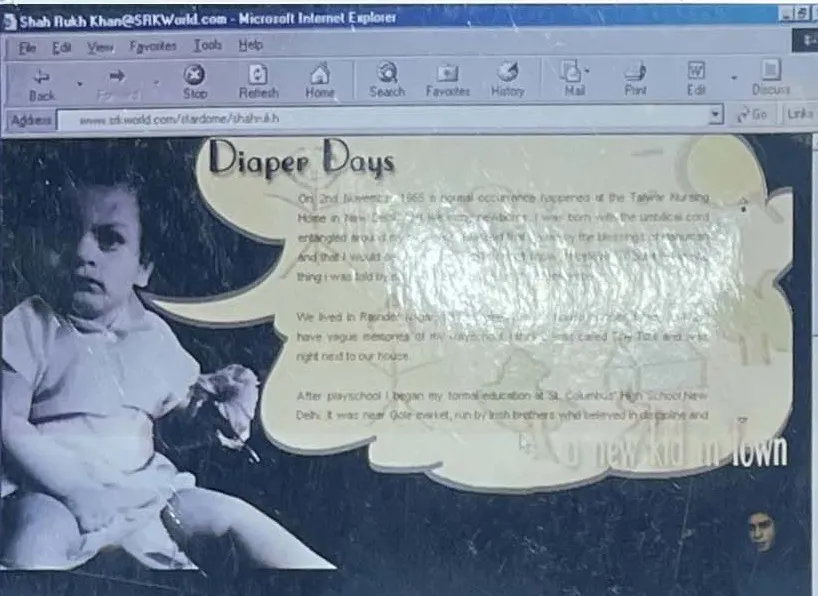
SRKWorld.com, 2000: "Diaper Days". (Archive: the author's collection)
The story starts before him. In 1946 Mir Taj Mohammed Khan, a young activist from Peshawar, came to Delhi to study law. He had campaigned with the Khudai Khidmatgar, the non-violent movement of Abdul Ghaffar Khan, the "Frontier Gandhi", and was affiliated with the Indian National Congress. Partition came the next year. He stayed in Delhi and did not see Peshawar again for many years. Fact
His son was born in New Delhi on 2 November 1965 and spent his first five years in Mangalore. The family lived a middle-class life in rented flats in Rajendra Nagar. Fact
Two families. His mother, Lateef Fatima, was a magistrate and the daughter of a senior government engineer; she and Mir Taj Mohammed Khan married in 1959. (Fact. Wikipedia: Shah Rukh Khan) Her father, Iftikhar Ahmed, was chief engineer of the port at Mangalore in the 1960s, which is why the boy born in Delhi spent his first five years on the Karnataka coast. (Fact. Wikipedia) He had one sibling, an elder sister, Shahnaz Lalarukh, born in 1960. (Fact. Wikipedia)
Many Indias in one boy. He has said his paternal grandfather was a Pashtun from Afghanistan. His father's cousins in Peshawar have said the family speaks Hindko and came originally from Kashmir. In 2010 he described himself as Hyderabadi on his mother's side, half Pathan on his father's, and partly Kashmiri through his grandmother. (Fact. Wikipedia) The accounts do not fully agree, and this book records them side by side rather than choosing one. Interpretation What they share is the shape of the man: a north-western father, a southern mother, a Delhi childhood and a Mumbai career, a Muslim who would marry into a Hindu family and raise children in both faiths. He would later sell that shape to the whole country as an idea of India. Interpretation
The father. The young lawyer from Peshawar did not practise for long. He ran several businesses, including a restaurant, and the family lived in rented flats in Rajendra Nagar. (Fact. Wikipedia) A 2026 report names the restaurant as Khatir and says Mir Taj Mohammed Khan also ran the mess at the National School of Drama. (Fact. The Siasat Daily, 22 June 2026) [Unverified: the restaurant's name and the NSD contract need a primary source, such as an NSD record or a family statement.] It is widely reported that he once stood for Parliament. [Unverified: the constituency, the year and the result need an Election Commission record before this book states them.]
The boy in the wings. In a 2014 interview he said he went to the National School of Drama every day after school while waiting for his sister, and spent much of his childhood among its actors. (Fact. Times of India interview, 2014, as reported by The Siasat Daily, 22 June 2026) The actor Pankaj Kapur, then a student at NSD in the mid-1970s, has recalled that a boy of about ten supplied the samosas at the interval, and that the boy was Shah Rukh Khan. (Eyewitness account, Pankaj Kapur, on Kindle Cast, as reported by The Siasat Daily) Kapur was unsure whether the boy's father or an uncle ran the canteen. [Unverified: which family member held the NSD canteen.]
Before he saw a film set, he grew up at the back of India's national drama school, carrying food to actors between acts. Interpretation The boy who served in the interval became the man whom crowds wait for outside his gate. Chapter 3 returns to the stage; Chapter 18 returns to the crowd. Interpretation
The father's dates. A photograph of his gravestone, published online in 2021, gives Mir Taj Mohammed Khan's birth as 27 October 1927, in Peshawar. (Fact. Alt News, 29 Oct 2021, citing the photograph) The date fits his son's tweet of 27 October 2014, which said his father would have been 87 that day. Fact. Alt News, citing the tweet The same check records that he was arrested during the Quit India movement of 1942, was in and out of jail for the next two years, and reached Delhi in 1946 to study law at Delhi University. (Fact. Alt News, citing the biographies King of Bollywood and Shahrukh Khan: The Story of the Man*)* It rated as false a viral claim that he was six years old in 1942. Fact. Alt News The young man who arrived in Delhi in 1946 was about nineteen and had already been to jail for his politics. Interpretation
The ballot of 1957. The election archive IndiaVotes lists three candidates for the Gurgaon seat in the 1957 Lok Sabha election: Maulana Abul Kalam Azad of the Congress, who won with 191,221 votes (66.68%); Mool Chand of the Bharatiya Jana Sangh, with 95,553; and an independent named Taj Mohammad, for whom it records no votes. Azad's margin was 95,668. (Fact. IndiaVotes: Gurgaon, 1957) Several reports identify that independent as Shah Rukh Khan's father. (Fact. NewsBytes; BollywoodShaadis) [Unverified: that the Taj Mohammad on the 1957 Gurgaon ballot is Mir Taj Mohammed Khan, and his real vote count; the Election Commission's statistical report for 1957 would settle both.] If the reports are right, a Peshawar-born lawyer of about thirty, with no party behind him, put his name on the same ballot as India's first education minister. Interpretation
Born between two wars. He was born six weeks after the ceasefire of 23 September 1965 that ended India's second war with Pakistan, the country that now held his father's birthplace. (Fact. Wikipedia: Indo-Pakistani war of 1965) He was nine when the Emergency was declared on 25 June 1975, the year this chapter closes. (Fact. Wikipedia: The Emergency) This book records the dates and draws no conclusion about what a child made of them. Method note
What the website said. In 2000 he gave his childhood its own room on his website and called it Diaper Days: a baby photograph and a first-person account of a Delhi birth. Archive: the author's collection, the screen above No other Indian star of the time put his own childhood online in his own words. [Unverified: a survey of Indian celebrity websites in 2000 would confirm or correct this.] The section title is his joke, not this book's. Eyewitness account, the author
What this chapter carries forward. A father who believed in non-violent resistance and lost his homeland to Partition; a mother who sat in judgement as a magistrate; a sister he would later look after; a childhood spent watching actors from the wings. Interpretation Every one of these returns: the father in Chapter 13, the sister in Room · Ram To Krishna, the wings in Chapter 3. Interpretation