Chapter 4
TV Cereal · Television, 1988 to 1991
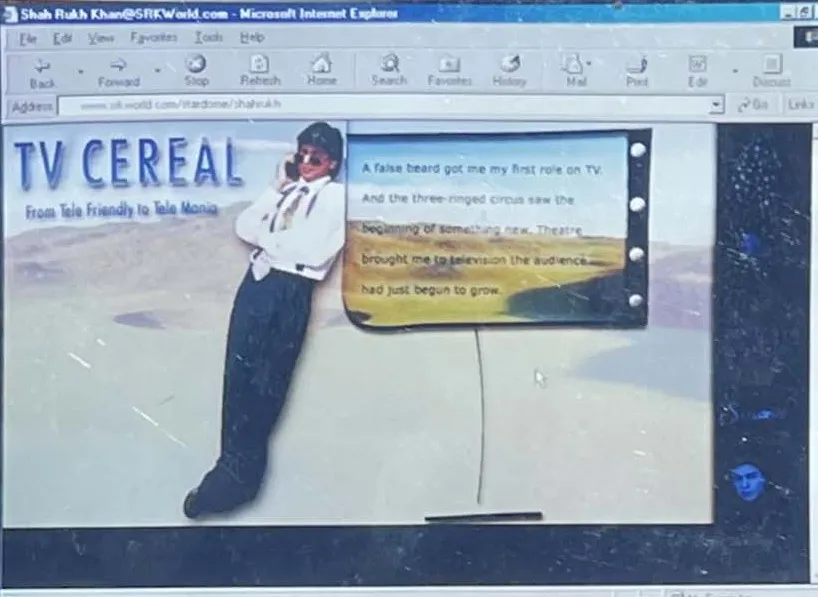
SRKWorld.com, 2000: "TV Cereal". (Archive: the author's collection)
He was meant to debut in a serial called Dil Dariya, but it was delayed, so the country first met him in 1989 as Abhimanyu Rai, the lead of Fauji. He followed it with Circus (1989 to 1990), directed by Aziz Mirza, and parts in Umeed, Wagle Ki Duniya and the English-language television film In Which Annie Gives It Those Ones. Fact
Fauji premiered on DD National on 18 January 1989: thirteen episodes about army recruits training to become commandos, directed by Lt. Col. Raj Kumar Kapoor. He was cast as a second lead. Kapoor said the camera "loved him so much" that the script was rewritten to make him the lead. (Fact. Wikipedia: Fauji; Scroll, 7 Dec 2015) Three years later he told India Today: "In six-and-a-half hours I became the nation's heartthrob." (Fact. quoted in The Hollywood Reporter India, Nov 2024)
The show's success brought work with the production company Iskra: Umeed, Wagle Ki Duniya and Circus. Fact. The Hollywood Reporter India Circus ran for nineteen episodes on DD National in 1989 and 1990, directed by Aziz Mirza and Kundan Shah, with him as Shekharan Rai. (Fact. Wikipedia: Circus) Aziz Mirza went on to direct Raju Ban Gaya Gentleman (1992), and in 1999 he, Juhi Chawla and Shah Rukh Khan founded Dreamz Unlimited, the company that later became Red Chillies. (Fact. Wikipedia: Red Chillies Entertainment) The circus tent of 1989 is where the business partnership of 1999 began. Interpretation
In Which Annie Gives It Those Ones (1989), Arundhati Roy's first screenplay, directed by Pradip Krishen, gave him a small early part. It aired once on Doordarshan and then all but disappeared. Restored in 4K from the original negative, it was selected for the Berlinale Classics in 2026. (Fact. The Statesman, 22 Jan 2026)
How he got Fauji. The part was first meant for the director's own son. Raj Kumar Kapoor wanted a new face instead, and his son-in-law, a property dealer who had met the young Khan while showing houses, put his name forward. (Fact. The Hollywood Reporter India, 28 November 2024) The audition was a run of a mile and a half at dawn, followed by boxing. (Fact. The Hollywood Reporter India) Other actors gave the director trouble; Khan did not, and the storyline and screen time moved to Lieutenant Abhimanyu Rai. (Fact. The Hollywood Reporter India) The sportsman who lost his sport to a shoulder injury (Chapter 2) won his first role by running and boxing. Interpretation
Iskra: the first mentors. Iskra was a Bombay production house run by Kundan Shah, Aziz Mirza and Saeed Mirza. After Fauji they cast him in Umeed, Wagle Ki Duniya and Circus, and mentored him. (Fact. The Hollywood Reporter India) All three men recur in this book. Kundan Shah directed him again in Kabhi Haan Kabhi Naa (Chapter 5). Aziz Mirza became his business partner in Dreamz Unlimited (Room · ArclightZ). A Mumbai dealer with a link to Saeed Mirza arranged his first meeting with Hyundai in 1998 (Room · Advantage). Fact. as cited in those sections The people he met in his first year on television built the next decade of his career with him. Interpretation
Idiot. Saeed Mirza also suggested him to Mani Kaul, who cast him as Pawan Raghurajan in an adaptation of Dostoevsky's The Idiot. (Fact. The Hollywood Reporter India; Wikipedia: Idiot (1992 film)) The film opened at the New York Film Festival in October 1992 and was shown in Mumbai in October 2016 as Ahamaq. (Fact. Wikipedia) The sources disagree on television: Wikipedia records a four-part Doordarshan miniseries in 1991, while The Hollywood Reporter India says it never aired. [Unverified: the Doordarshan broadcast, from the channel's records.] In the same years, the boy from the Delhi theatre worked with the art cinema of Mani Kaul and Arundhati Roy and with the mass television of Fauji. Interpretation
Television in 1989. India had one national channel, Doordarshan. Every Fauji episode reached the whole television audience at once; there was no other channel to watch. Interpretation [Unverified: the number of television households in India in 1989, from Doordarshan or the census.] Six and a half hours of air time, thirteen half-hour episodes, were enough to make him known across the country. (Fact. 13 episodes, The Hollywood Reporter India; his 1992 line, as above)
In 1991 his mother died. In April that year he decided to act in films and moved from Delhi to Mumbai, taking on the care of his older sister, Shahnaz. On 25 October 1991 he married Gauri. (Fact. Marriage: Wikipedia: Gauri Khan)
The first film he signed, that same year, was Hema Malini's Dil Aashna Hai. By the time it released, on 25 December 1992, Deewana had already made him a film star. (Fact. Wikipedia: Dil Aashna Hai)
Television was his first direct line into people's homes. A single national channel, one evening a week, and a whole country watching the same face. It was a mass medium with no middleman, and he would spend the next thirty-five years looking for its successor: his own website in 2000, Twitter, Google+, and in 2026 the fans' own AI. Interpretation The beginning keeps coming back: Doordarshan re-ran Circus during the 2020 lockdown and Fauji in 2024. (Fact. ETV Bharat, 28 Mar 2020; The Hollywood Reporter India)
He arrived with no film family, no godfather and no money, a television face in an industry of dynasties. Everything he built after that, he built in public. Interpretation