Chapter 6
Going Digital · The producer, the website and the fall, 1999 to 2003
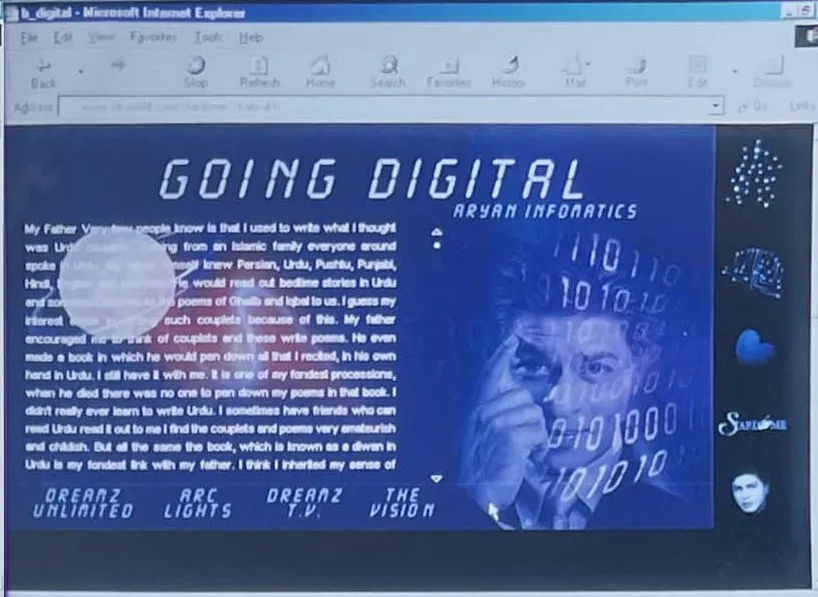
SRKWorld.com, 2000: "Going Digital", under the Aryan Infomatics name. (Archive: the author's collection)
The myth was written. In 1999 he set out to own a share of it. Interpretation
1999: the star becomes a producer. He had one release that year, Baadshah, a comic caper opposite Twinkle Khanna. It underperformed at the box office but earned him a Filmfare nomination for Best Performance in a Comic Role. (Fact. Wikipedia: Shah Rukh Khan) The bigger move of the year happened off screen. In 1999 he became a producer, as a founding partner of Dreamz Unlimited with Juhi Chawla and Aziz Mirza, the director who had given him Raju Ban Gaya Gentleman in 1992. (Fact. Wikipedia: Shah Rukh Khan; Juhi Chawla's own Wikipedia entry dates the company to 2000: Wikipedia: Juhi Chawla) Between 1999 and 2003 the partnership produced three films. (Fact. Wikipedia: Shah Rukh Khan)
Baadshah, by the trade's numbers. Baadshah was released on 27 August 1999, directed by Abbas–Mustan and produced by Ganesh Jain with Bhawar and Girish Jain. Made for ₹11 crore, it grossed ₹31.60 crore worldwide, and Box Office India rated it "Average". (Fact. Wikipedia: Baadshah (1999 film)) The two pages read the same result differently: "underperformed" on his own page, "Average" in the trade verdict on the film's. Fact; the two sources differ in wording
The partners were the same three people who had made his first comedy hit. A star who had been hired for ten years now wanted to choose the story, cast it and keep a share of what it earned. Interpretation
The audience was changing its address too. In August 1999 B4U Movies launched in the United Kingdom on Sky Digital, and within six months it was on television platforms in the United States, Canada, Europe and the Middle East. One of its founders was Kishore Lulla. (Fact. Wikipedia: B4U (network)) The diaspora that had found him on video cassettes in the 1990s could now watch Hindi films on a dedicated channel. A year later Lulla's name would appear again, on the list of promoters of his website. Fact. exchange4media, 15 Nov 2000; see below
January 2000: the first production. Phir Bhi Dil Hai Hindustani, directed by Aziz Mirza, opened on Friday 21 January 2000 across 240 screens. It was the debut production of Dreamz Unlimited, made on a budget of ₹13 crore. (Fact. Wikipedia: Phir Bhi Dil Hai Hindustani) He and Juhi Chawla played rival television reporters in a satire on the news channels' race for ratings. (Fact. Wikipedia: Phir Bhi Dil Hai Hindustani)
It opened a week after Kaho Naa... Pyaar Hai, the debut of Hrithik Roshan, and failed. (Fact. Wikipedia: Shah Rukh Khan) It grossed about ₹25.46 crore worldwide, ₹18.20 crore of it in India, and Box Office India declared it a flop. Khan later called it the biggest failure for Juhi, Aziz and himself. (Fact. Wikipedia: Phir Bhi Dil Hai Hindustani) The music did well, and the film's special effects won an IIFA award. (Fact. Wikipedia: Phir Bhi Dil Hai Hindustani)
Two reporters, two channels. He played Ajay Bakshi of KTV; Juhi Chawla played Ria Banerjee of Galaxy TV. Jatin–Lalit composed the songs and Javed Akhtar wrote all the lyrics. (Fact. Wikipedia: Phir Bhi Dil Hai Hindustani)
The first film he owned was about the media. Its target was television news chasing ratings. Its subject was the question that would run through his career: who controls the picture the audience sees. Interpretation
The rest of 2000 kept him in front of the camera. In February he made his Tamil debut in Kamal Haasan's bilingual Hey Ram, in a supporting role he played free of charge. (Fact. Wikipedia: Shah Rukh Khan) He played a Goan gang leader in Josh and made special appearances in Har Dil Jo Pyar Karega and Gaja Gamini. (Fact. Wikipedia: Shah Rukh Khan filmography)
Hey Ram and Josh, by the numbers. Hey Ram opened on 18 February 2000, in Tamil and Hindi at once. He played Amjad Ali Khan, a Pathan friend of Kamal Haasan's hero, and dubbed his own lines. (Fact. Wikipedia: Hey Ram) The film cost ₹11 crore, excluding Haasan's salary, and failed commercially; the Hindi version grossed ₹8.91 crore in India and $550,000 overseas. It was India's entry for the Academy Awards and was not nominated. Fact. same source
Josh, directed by Mansoor Khan, followed on 9 June 2000, with him as Max Dias, twin brother of Aishwarya Rai's Shirley. (Fact. Wikipedia: Josh (2000 film)) Made for ₹16 crore, it grossed ₹35.06 crore worldwide, ₹30.05 crore of it in India, and Box Office India rated it "Average". Fact. same source It was also his debut as a singer, on "Apun Bola" with Hema Sardesai; the album sold about 1.8 million units, the year's ninth-best seller. Fact. same source
Venus, twice. Josh was produced by Ganesh, Ratan and Champak Jain under the Venus Films banner, and Baadshah by Ganesh Jain with Bhawar and Girish Jain. (Fact. Wikipedia: Josh (2000 film); Wikipedia: Baadshah (1999 film)) In November 2000 a music company named Venus joined SRKWorld's film-music library (see below). Fact. Bollywood Hungama, Nov 2000 [Unverified: whether Venus Films and the Venus music label named at the SRKWorld launch are the same Jain family business] If they are, the producers of two of his three releases with a full role outside his own company in 1999 and 2000 were also partners in his portal. Interpretation
2000: the internet year. The internet had arrived in India only five years earlier. On 15 August 1995 the state-owned VSNL launched the first public service, at 9.6 kbit/s, priced at ₹5,200 for 250 hours. (Fact. Wikipedia: Internet in India) For the next decade most Indian users stayed on narrow-band connections below 56 kbit/s. (Fact. Wikipedia: Internet in India)
The connection gap, 1999 to 2004.
| Year | Internet users per 100 people (World Bank, calendar year) | Internet subscriptions, end of March (TRAI) | Mobile subscriptions, end of March (TRAI) | Fixed telephone lines, end of March (TRAI) |
|---|---|---|---|---|
| 1999 | 0.27 | N/A (TRAI series starts March 2000) | N/A (TRAI series starts March 2000) | N/A (TRAI series starts March 2000) |
| 2000 | 0.53 | 0.95 million | 1.90 million | 26.65 million |
| 2001 | 0.66 | 3.04 million | 3.58 million | 32.71 million |
| 2002 | 1.54 | 3.42 million | 6.54 million | 38.33 million (38.43 million in another TRAI table) |
| 2003 | 1.69 | 3.64 million | 13.00 million | 41.49 million |
| 2004 | 1.98 | 4.55 million | 33.69 million | 42.84 million |
(Fact. World Bank, World Development Indicators, via FRED series ITNETUSERP2IND; TRAI, Performance Indicators for FY 2003-04, July 2004. The two series measure different things: people using the internet in a calendar year, and paid connections at the end of a financial year. TRAI's mobile totals include limited-mobility WLL, and it marks the data provisional.)
When srkworld.com went live, the World Bank figure for 2000 meant about one Indian in 190 used the internet at all. Interpretation, arithmetic on the table Over the four years of this chapter, mobile subscriptions grew almost eighteen times, from 1.90 million to 33.69 million, while internet subscriptions stayed under five million. Interpretation, arithmetic on the table The device that would one day carry his audience was arriving; the connection his site needed was not. Interpretation
The law for a website. The Information Technology Act, 2000, which gave electronic records and digital signatures legal recognition and defined offences such as hacking, was notified on 17 October 2000, four weeks before srkworld.com went live. (Fact. Wikipedia: Information Technology Act, 2000) The same page gives two dates for presidential assent, 9 May and 9 June 2000. Fact. same source; the page is inconsistent
The money, though, believed in it. Satyam Infoway listed on NASDAQ in October 1999. (Fact. Wikipedia: Sify) On 14 June 2000 Rediff.com followed, raising $55.2 million at $12 a share and closing its first day at 19-5/16. (Fact. CNN Money, 14 June 2000) Satyam paid ₹325.4 crore on 30 June 2000 for the rest of the portal IndiaWorld. (Fact. Wikipedia: Sify) By then the bubble had already peaked: NASDAQ reached 5,048 on 10 March 2000. (Fact. Goldman Sachs: the 2000 dot-com bubble)
Television moved faster. On 3 July 2000 Kaun Banega Crorepati premiered on Star Plus with Amitabh Bachchan as host, took the channel to number one for the first time and reinvented his career. (Fact. Wikipedia: Kaun Banega Crorepati) The older star went back to the medium that had made the younger one. The younger one went looking for the next medium. Interpretation
Aryan Infomatics: building the line. With Dreamz Unlimited came something no Indian star had tried: a website of his own, srkworld.com. (Fact. Wikipedia: Shah Rukh Khan) It was launched through a technology company called Aryan Infomatics, named after his first son, Aryan. The author co-founded it with him and co-led it as co-CEO. The two of them designed the site's interface themselves, in Photoshop, Illustrator and Dreamweaver. Eyewitness account The company's registered name appears in the trade press of the time as Aryan Informatics (I) Pvt. Ltd. (Fact. Bollywood Hungama, Nov 2000)
The platform's technology was built by a second company, TechShastra India Pvt Ltd, which the author co-led as co-CEO with Nishith Shah, with Khan as its silent partner. Eyewitness account [Unverified: TechShastra's registration papers or incorporation date]
This was the first direct line since Doordarshan. In 1989 a state channel had carried him into every home that had a set. In 2000 he tried to build the channel himself, with his own name on the address. Interpretation
The archive shows what they built. The site's pages, photographed on Internet Explorer screens in 2000, carry its sections: "Going Digital" under the Aryan Infomatics banner, an "Opening Office" linking Aryan Infomatics, Arc Lights, Dreamz TV and The Vision, "Stardome" with pages for Juhi Chawla, Anil Kapoor, Johny Lever and Sushmita Sen, "The Wall" of film posters, "TV Cereal", "Ad-vantage" for his brand work, "Karma Cola", "Travel Bug", "The Galleria", his school days at St. Columba's, and a news page, "The Third Eye", dated 11 November 2000. The tagline ran around a globe: "There's always a different way to look at things." Archive: screen photographs, 2000 Arclightz Films was the company that co-produced Asoka with Dreamz Unlimited the following year. (Fact. Wikipedia: Asoka) [Unverified: whether "Arc Lights" on the site is the same company as Arclightz Films]
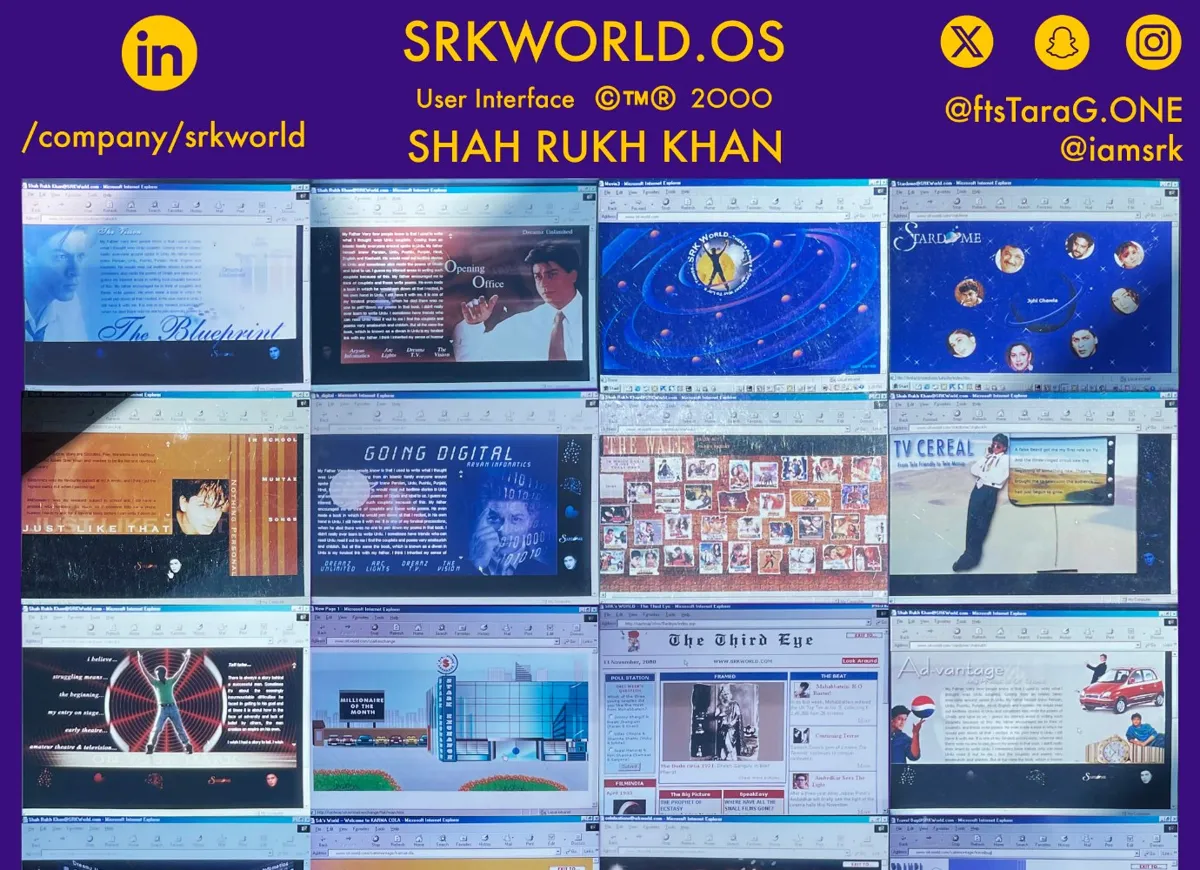
October 2000: the teacher and the rebel. Two weeks before the website went live, the cinema gave him the year's biggest hit. Aditya Chopra's Mohabbatein was released on 27 October 2000 and set him, as a music teacher who believes in love, against Amitabh Bachchan as the headmaster who forbids it. (Fact. Wikipedia: Mohabbatein) It was the highest-grossing Indian film of the year. The worldwide figure is given as about ₹90 crore by Box Office India and as ₹76.01 crore in the film's own infobox. (Fact. Wikipedia: Mohabbatein; the two figures disagree) It won four Filmfare Awards, among them Best Supporting Actor for Bachchan and the Critics Award for Best Actor for Khan, his second. (Fact. Wikipedia: Mohabbatein; Wikipedia: Shah Rukh Khan)
The same month the film business was given a new legal footing. In October 2000 the government gave films industry status under the IDBI Act of 1964, so that producers could borrow from banks. (Fact. ICMR case study: Film insurance and financing in India) Bank finance was slow to follow. Fact. ICMR, same page
14 November 2000: srkworld.com goes live. On 14 November 2000 he presented SRKWorld himself, at a press conference in front of the SRKWorld backdrop. A preview for the press was held the day before, on 13 November. Archive: press conference photographs, 13 and 14 November 2000 The launch was held at The Taj in Mumbai. (Fact. Bollywood Hungama, Nov 2000)
The trade press reported it the next morning. On 15 November 2000 exchange4media wrote that "film star Shah Rukh Khan has launched an entertainment portal srkworld.com", with an initial investment of $1 million. It named the promoters as the producer Bharat Shah, Kishore Lulla, the industrialist Jay Mehta and the actress Juhi Chawla, with B4U to provide software and content for broadband. (Fact. exchange4media, 15 Nov 2000)
Bollywood Hungama gave more detail. The company behind the portal was promoted by Khan and Juhi Chawla with Bharat Shah and Kishore Lulla "of B4U", and its board included Jay Mehta and Gauri Khan. Microsoft and Compaq were named as technical associates, and the music companies Venus and Tips joined for a film music library. (Fact. Bollywood Hungama, Nov 2000; the page carries a wrong date, 1 June 2000, but describes the 14 November launch) The two reports differ on B4U: exchange4media lists Bharat Shah and Kishore Lulla as promoters in their own names, while Bollywood Hungama places both at B4U, a network whose own history names Lakshmi Mittal and Kishore Lulla as founders. (Fact. exchange4media; Bollywood Hungama; Wikipedia: B4U (network))
The site had about 14 sections. Its main attraction was "Stardome", with official pages for Khan and Juhi Chawla, and Anil Kapoor, Sushmita Sen, Rani Mukerji, Namrata Shirodkar, Johny Lever and Santosh Sivan named as joining. It promised family photographs, stills from every film he had made, concert videos, animated films, and broadband content and live shows online. (Fact. Bollywood Hungama, Nov 2000) The plan was a star's portal that would also be a studio, a music library and a broadcaster, on a network where most homes still dialled in. Interpretation
The launch was widely covered at the time. By the author's count there were about 500 articles in November and December 2000, an Outlook cover with Khan and Juhi Chawla and a centre-spread story, and a live interview on CNBC. Eyewitness account [Unverified: clippings to be added] Much of that coverage can no longer be found online, which is why Khan asked her to put the photographs and the video below on public record. Eyewitness account
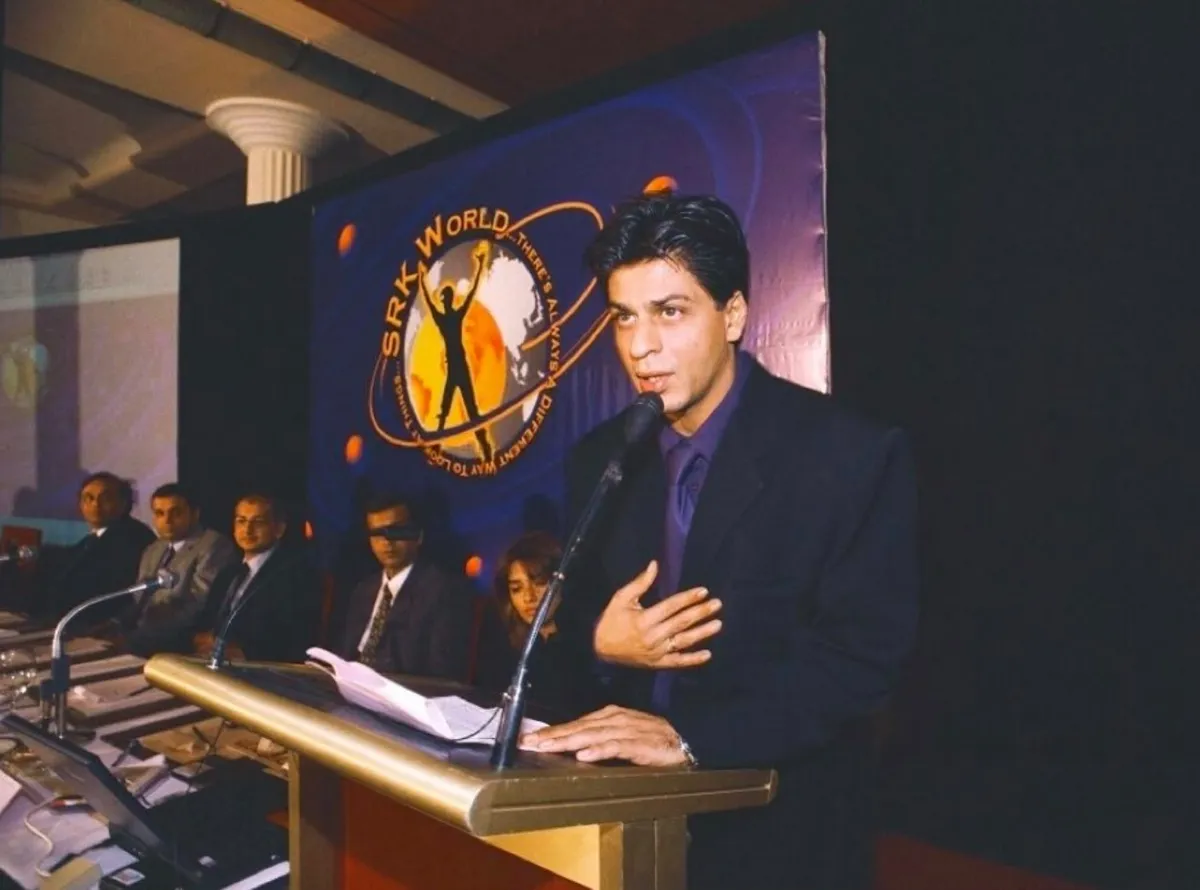
Seated at the table, left to right: Bharat Shah, Sunil Lulla (Kishore Lulla's brother), Jay Mehta, Nishith V. Shah and Shailja Gupta, the author. Shah Rukh Khan stands at the podium, presenting to the press. (Eyewitness account; Archive photograph, 14 November 2000)
The site also gave him a second self. Together, the author and he created the character ShahRocK and Bubbles, later Shah Rock Jaan. Eyewitness account [Unverified: the year the character was first drawn, and its first appearance] A star who had become a myth on screen now had a cartoon of himself made for the screen of a computer. Interpretation
2001: the sword and the crash. The money that had believed in the internet left as fast as it had come. NASDAQ, 5,048 at its peak in March 2000, fell to 1,139.90 by 4 October 2002, a loss of 77%. (Fact. Goldman Sachs: the 2000 dot-com bubble) In India the infrastructure for what srkworld.com promised did not yet exist: the government only defined broadband, as an always-on connection of at least 256 kbit/s, in its 2004 policy. (Fact. Wikipedia: Internet in India)
His first release of 2001, One 2 Ka 4, a police thriller opposite Juhi Chawla, came and went. (Fact. Wikipedia: Shah Rukh Khan filmography) [Unverified: box office figure for One 2 Ka 4] Dreamz Unlimited's second production was meant to be its comeback. (Fact. Wikipedia: Shah Rukh Khan)
One 2 Ka 4, by the numbers. It was released on 30 March 2001, directed by Shashilal K. Nair and produced by Nazir Ahmed, with Jackie Shroff in the cast and music by A. R. Rahman. Made for ₹12 crore, it grossed ₹13.82 crore worldwide, and Box Office India declared it a "disaster". (Fact. Wikipedia: One 2 Ka 4) Taran Adarsh gave it one star of five, calling it "handicapped by a weak script". Fact. same source The open item above stays until a trade record confirms these figures. Method note
Santosh Sivan had first approached him about Asoka on the set of Dil Se.., while Khan was dancing on the roof of a train for "Chaiyya Chaiyya". "I was hooked," Khan recalled. (Fact. quoted in Wikipedia: Asoka) The film, in which he played the emperor who gave up his sword, was made for about ₹12.5 crore by Dreamz Unlimited and Arclightz Films and released on 26 October 2001 across 235 screens. (Fact. Wikipedia: Asoka)
It was selected for the Venice and Toronto film festivals, where it was well reviewed. (Fact. Wikipedia: Asoka) At home it was a box-office failure: ₹11.54 crore net in India, the 13th-highest earner of the year, against $1.8 million overseas, the fourth-highest Indian film abroad that year. (Fact. Wikipedia: Asoka) It won Best Cinematography for Santosh Sivan at the Filmfare and IIFA awards. (Fact. Wikipedia: Asoka)
Critics abroad were kinder than the box office at home. In London, Peter Bradshaw of The Guardian called it "a big, brash and deeply enjoyable Bollywood epic", and all ten reviews counted by Rotten Tomatoes were positive. (Fact. quoted in Wikipedia: Asoka) In India his emperor divided reviewers; one called the performance "all bluster and mannerism". (Fact. quoted in Wikipedia: Asoka) He won Best Actor for it at the Sansui Awards. (Fact. Wikipedia: Asoka)
The pattern was now plain. The audience abroad followed him into new forms; the audience at home wanted him in the form it knew. Interpretation Asoka is also the first word of the essay that gives Part Three its name, Asoka to Boo-Da: the emperor who lays down his sword returns in Part Three as a man who goes silent. Interpretation
As the losses mounted, srkworld.com was closed. Fact Wikipedia dates the closure to 2001 and gives the losses of Dreamz Unlimited as the reason. (Fact. Wikipedia: Shah Rukh Khan) [Unverified: the exact month the site went offline] Broadband barely existed in India, and smartphones were years away. The idea closed. The ambition did not. Interpretation Eleven years later, on a stage in Mumbai, he would describe that company to an audience as the one with which the two of them had lost everything (see Chapter 9). Archive: video of the event, 2011
The family film arrived seven weeks after Asoka. Karan Johar's Kabhi Khushi Kabhie Gham, released on 14 December 2001 and distributed in more than 100 countries, grossed about ₹1.36 billion worldwide and $8.9 million overseas. It was the highest-grossing Indian film overseas at the time, a record it held until Kabhi Alvida Naa Kehna in 2006. (Fact. Wikipedia: Kabhi Khushi Kabhie Gham) Its budget is given as ₹30 crore to ₹40 crore. Fact. same source
In London, Johar recalled, an exhibitor told him the film was third at the UK box office, behind the first Harry Potter and the first Lord of the Rings: "There are queues in the cold to see this film." (Fact. quoted in Bollywood Hungama, 16 Oct 2023) Kabhi Khushi Kabhie Gham he calls a turning point. Fact [Unverified: source and exact words of his "turning point" remark]
Johar also remembered a London audience standing to applaud a scene about belonging, and what it taught him: there was "some kind of a connection" between his film and the diaspora. (Fact. quoted in Bollywood Hungama, 16 Oct 2023) At the 47th Filmfare Awards the film won five, including Best Actress for Kajol and Best Supporting Actress for Jaya Bachchan. (Fact. Wikipedia: Kabhi Khushi Kabhie Gham) The audience that had queued for Dilwale Dulhania Le Jayenge in 1995 was now the biggest overseas market any Indian film had found. Interpretation
The year ended in pain. In December 2001 he injured his spine during an action sequence for a special appearance in Shakti: The Power, and was diagnosed with a prolapsed disc. (Fact. Wikipedia: Shah Rukh Khan) Alternative treatments brought no lasting relief, and the pain followed him onto several sets. Fact. same source
2002: Cannes. He worked through the injury. Hum Tumhare Hain Sanam came out in May 2002, and he made special appearances in Shakti: The Power and Saathiya later that year. (Fact. Wikipedia: Shah Rukh Khan filmography)
The delayed film. Hum Tumhare Hain Sanam opened on 24 May 2002, the day after Devdas premiered at Cannes. K. S. Adhiyaman directed it, with Salman Khan and Madhuri Dixit, after production problems had delayed it for six years. (Fact. Wikipedia: Hum Tumhare Hain Sanam; Cannes date below) Made for ₹12 crore, it grossed ₹34.76 crore worldwide; most critics were negative. Fact. same source A film shot across six years reached cinemas in the week his costliest film reached Cannes. Interpretation
The film of the year was Sanjay Leela Bhansali's Devdas. It premiered out of competition at the Cannes Film Festival on 23 May 2002, the first big commercial Bollywood film to walk that red carpet, and opened worldwide on 12 July. (Fact. Wikipedia: Devdas; Eastern Eye, 7 July 2022) It cost about ₹50 crore, then the most expensive Bollywood film made. (Fact. Wikipedia: Shah Rukh Khan; Wikipedia: List of accolades received by Devdas)
The sources disagree on what it earned. Khan's own Wikipedia entry gives about ₹1.68 billion worldwide; the list of the film's accolades gives ₹998.8 million and calls it the highest-grossing Indian film of the year. (Fact. Wikipedia: Shah Rukh Khan; Wikipedia: List of accolades received by Devdas) Devdas became India's Oscar entry and was nominated for the BAFTA for Best Film Not in the English Language. (Fact. Wikipedia: Devdas; Wikipedia: List of accolades received by Devdas) It won five National Film Awards. Fact. same source
At the 48th Filmfare Awards he won Best Actor for it. The film's total is given as 10 Filmfare Awards in his Wikipedia entry and as 11 of 17 nominations in the list of its accolades. (Fact. Wikipedia: Shah Rukh Khan; Wikipedia: List of accolades received by Devdas) He also hosted that ceremony, broadcast as a television special in 2003. (Fact. Wikipedia: Shah Rukh Khan filmography)
He took the stage abroad as well. In 2002 he headlined From India With Love with Amitabh Bachchan, Aamir Khan, Preity Zinta and Aishwarya Rai, at Old Trafford in Manchester and Hyde Park in London; more than 100,000 people attended. (Fact. Wikipedia: Shah Rukh Khan) The direct line had gone offline. The live one, star and audience in the same field, was bigger than ever. Interpretation
The brand grew with the films. From 1999 his work in television advertising increased significantly, with the Hyundai Santro partnership of 1998 running through the whole period (see Chapter 5). (Fact. Wikipedia: Shah Rukh Khan in the media; Storyboard18) Box Office India, which had ranked him the top actor in 1995 and 1998, put him first again in 2002 and every year to 2008. (Fact. Wikipedia: Shah Rukh Khan in the media) [Unverified: list of brands he endorsed in 2000 to 2003, with years] The company he co-owned had failed; the name it was built on had never been worth more. Interpretation
2003: the neck and the split. The body paid. Early in 2003 he had anterior cervical discectomy and fusion surgery at Wellington Hospital in London. (Fact. Wikipedia: Shah Rukh Khan) He returned to work in June with a reduced load. Fact. same source
The third and last Dreamz Unlimited production, Chalte Chalte, directed by Aziz Mirza and made in association with UTV Motion Pictures, was released on 13 June 2003; Variety put its budget at $5 million. (Fact. Variety, 13 June 2003) It was a success. (Fact. Wikipedia: Shah Rukh Khan) That year the Dreamz Unlimited partnership ended, after a dispute over casting Juhi Chawla in Chalte Chalte; the partners parted ways despite the film's success. (Fact. Wikipedia: Shah Rukh Khan)
Chalte Chalte, by the numbers. Wikipedia puts its budget at ₹11 crore, against Variety's $5 million above. (Fact. Wikipedia: Chalte Chalte (2003 film); Variety, 13 June 2003) It grossed ₹43.28 crore worldwide, ₹30.15 crore in India and $2.81 million (₹13.13 crore) overseas, and Box Office India called it a "hit". Fact. same source; its lead gives US$5.4 million worldwide and its box-office section US$4.5 million Rani Mukerji played opposite him as Priya. By Khan's account she first declined for Saathiya; Aishwarya Rai was signed and then replaced, and Kajol declined because she was pregnant. Fact. same source Jatin–Lalit and Aadesh Shrivastava wrote the songs, and the album sold about 1.8 million units, sixth for the year. Dreamz Unlimited designed the film's publicity itself. Fact. same source
When Dreamz became Red Chillies. The film's page says Dreamz Unlimited was rebranded as Red Chillies Entertainment in 2003. (Fact. Wikipedia: Chalte Chalte (2003 film)) The Red Chillies page, followed in Chapter 7, has the company registered in 2002 and Dreamz folded into it in 2004. (Fact. Wikipedia: Red Chillies Entertainment; the sources differ) [Unverified: the dates of Red Chillies' incorporation and of the Dreamz merger, from the Registrar of Companies]
The year closed on a high. Karan Johar's production Kal Ho Naa Ho, written by Johar and directed by Nikhil Advani, opened on 28 November 2003. (Fact. Wikipedia: Kal Ho Naa Ho) It grossed about ₹86.09 crore worldwide, by Box Office India's estimate, and was the highest-grossing Indian film of 2003; in India alone it was second, behind Koi... Mil Gaya. (Fact. Wikipedia: Kal Ho Naa Ho) It won eight Filmfare Awards from eleven nominations, the most of any film that year. Fact. same source
For five years the pattern held: when he made something of his own, it lost money; when he played for others, it broke records. Interpretation Phir Bhi Dil Hai Hindustani, Asoka and srkworld.com failed, Chalte Chalte succeeded and still ended the partnership, while Mohabbatein, Kabhi Khushi Kabhie Gham, Devdas and Kal Ho Naa Ho made him the most bankable star of the decade abroad. Interpretation, on the facts above
The first direct line had been built too early. It needed fast connections, cheap phones and a habit of looking at a screen for a star, and India had none of the three. What it proved was that he wanted the line, and that a fan could build it with him. Interpretation
At the end of 2003 he had the year's biggest hit, a fused neck and no company of his own. What he built next, he would own outright. Interpretation