Chapter 9
The Wall II · Ra.One, 2011: building a digital kingdom
Ra.One premiered in Dubai on 24 October 2011 and opened in India on 26 October, the Diwali weekend. (Fact. Wikipedia) On screen it was a superhero film: a game designer builds a villain for his son, the villain escapes the game, and a hero called G.One steps out of the code to stop him. Off screen it was the most ambitious attempt Indian cinema had made to build an intellectual property rather than a film. The campaign ran for nine months on a reported marketing budget of ₹52 crore, about ₹15 crore of it on the internet. Fact. Wikipedia
The figures were reported differently at the time. A month before release, Business Today put the marketing budget at about ₹40 crore, ₹15 crore of it online, against a production cost of about ₹160 crore. It also reported ₹77 crore for distribution rights, ₹35 crore for satellite rights and ₹5 crore for the game, with industry sources expecting about 80% of the cost to be recovered before release. (Fact. Business Today, 27 Sept 2011; the 80% is an industry estimate)
The brief was not to sell tickets for a weekend. It was to build a universe that would outlive the weekend: a character with its own visual identity, products, games and stories, able to travel from screen to shelf to phone.
What was built. The campaign combined:
- A character system: G.One got a style guide with rules for colour, pose and proportion, so any partner could reproduce the hero correctly. The author created the illustrated G.One art, the style guide, Little G.One and the G.One comic. Eyewitness account; the style guide and comic are in the author's archive
- Merchandise and licensing: toys, PC tablets and apparel Fact. Wikipedia. The FICCI-KPMG media report of 2012 called it "one of the longest and the most elaborate marketing campaigns in the history of Indian cinema", a 360-degree campaign that "leveraged digital and merchandising platforms", and noted that the first look was unveiled on a social network (Fact. KPMG-FICCI Report 2012). The report gives no count of products. The earlier draft's figure of 64 merchandise items comes from the author's own licensing work: [Unverified: licensing records to be supplied by the author]
- Games: Ra.One – The Game for PlayStation 2 and 3, made with Sony Computer Entertainment Europe and released on 5 October 2011, and a social game, Ra.One Genesis, with UTV Indiagames Fact. Wikipedia
- Website and live events: the official site launched on 31 May 2011, with a YouTube channel and a gaming tournament in Mumbai streamed on YouTube Fact. Wikipedia
- Brand partners: tie-ins across categories, including a Horlicks special-edition Ra.One pack with a G.One mug and a draw to meet the cast (Fact. afaqs)
- Digital first: a hero who lived online before he lived on screen, built by a team that ran digital as part of the product, not as its advertising Eyewitness account
A month before release the campaign had six brand partners: Western Union, which ran a million-dollar global campaign, Linc pens, Horlicks, McDonald's, Sony Computer Entertainment Europe and YouTube. McDonald's Happy Meals carried a G.One robot toy. An official G.One store sold everything from piggy banks to limited-edition toys, with a loyalty programme. A custom YouTube channel carried behind-the-scenes footage, a 40-page digital comic sat on the official site, and the star video-chatted with fans on Google+. (Fact. exchange4media, 27 Sept 2011)
In 2011 that was unheard of for a Hindi film: a star talking to fans by live video, a hero sold in fast-food boxes, a comic and a game released before the film. Interpretation
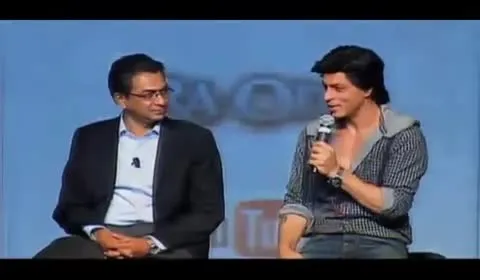
The digital launch was a stage event of its own. In Mumbai the star launched the film's YouTube channel and Google+ presence together with Google, saying he "wanted to leverage the full potential of digital media". The launch included a contest in which fans competed for the most views. (Fact. Business Today, 27 Sept 2011; Campaign India: a dedicated channel with social games, a digital comic and contests) The author was on that stage, introduced by the star himself. Eyewitness account; archive video
Eleven years after SRKWorld he said it himself, on stage (see Chapter 6). At the Mumbai launch, in September 2011, of Ra.One's partnership with Google and YouTube, seated beside Rajan Anandan, then head of Google India, he introduced the author to the audience: a young woman who used to work with him, with whom, years earlier, he had started a company, and lost everything. She had gone on to film-making and digital work, he said, and had left her job to make the Ra.One digital campaign happen. (Archive: video of the event, uploaded by the author at Khan's request. Paraphrase from an automatic transcript; his exact words to be confirmed)
On 20 October 2011 he held a live chat with fans on Google+, the first Indian film personality to do so. Fact. Wikipedia The social game Ra.One Genesis ran on Facebook, Twitter, iPhone, iPad, Android, Nokia's Ovi Store and DTH, and the film's Facebook page passed three lakh likes. (Fact. Social Samosa, Nov 2011) Akon sang "Chammak Challo", the song that carried the campaign. Fact. Wikipedia
The brand list kept growing: Ducati, Tommy Hilfiger, Videocon, TAG Heuer and Volkswagen were signed a month out Fact. Business Today, more than 25 brands in all by release, subsidising much of the marketing spend (Fact. Moneylife). Outdoors, 1,700 billboards were planned. Fact. Business Today
It grossed more than ₹207 crore worldwide. (Fact. Box Office India, via Wikipedia)
Its visual effects won the National Film Award and the Filmfare Award for Best Special Effects. Fact. Wikipedia Its marketing won too: Best Marketed Movie of the Year at the ETC Bollywood Business Awards on 9 January 2012, and Best Marketed Film and Best Use of New Media at the Zee Cine Awards on 21 January 2012. (Fact. Wikipedia: accolades of Ra.One; the Zee wins are stated in the article text)
What it proved, and what it left unfinished. A franchise needs more than a launch. It needs continuity, rights management, investment and, above all, a reason for the audience to keep playing after the credits. Ra.One delivered the launch. The universe never got its second chapter. Interpretation
In 2011, most Indian film campaigns treated the internet as a place to upload a trailer. Ra.One treated it as part of the product. The industry would take more than a decade to catch up, and when it did, the tools would be AI and the builders would be the fans. Interpretation
Two years later, the same team asked a harder question: what if the audience was not only the market for the campaign, but its engine?