Part II · The First Digital Empire Starts With…, 2000 to 2013 · 10 of 57
Chapter 8 · The KKR Years: the institution, 2004 to 2009
[image: SRKWorld.com, 2000: Opening Office]
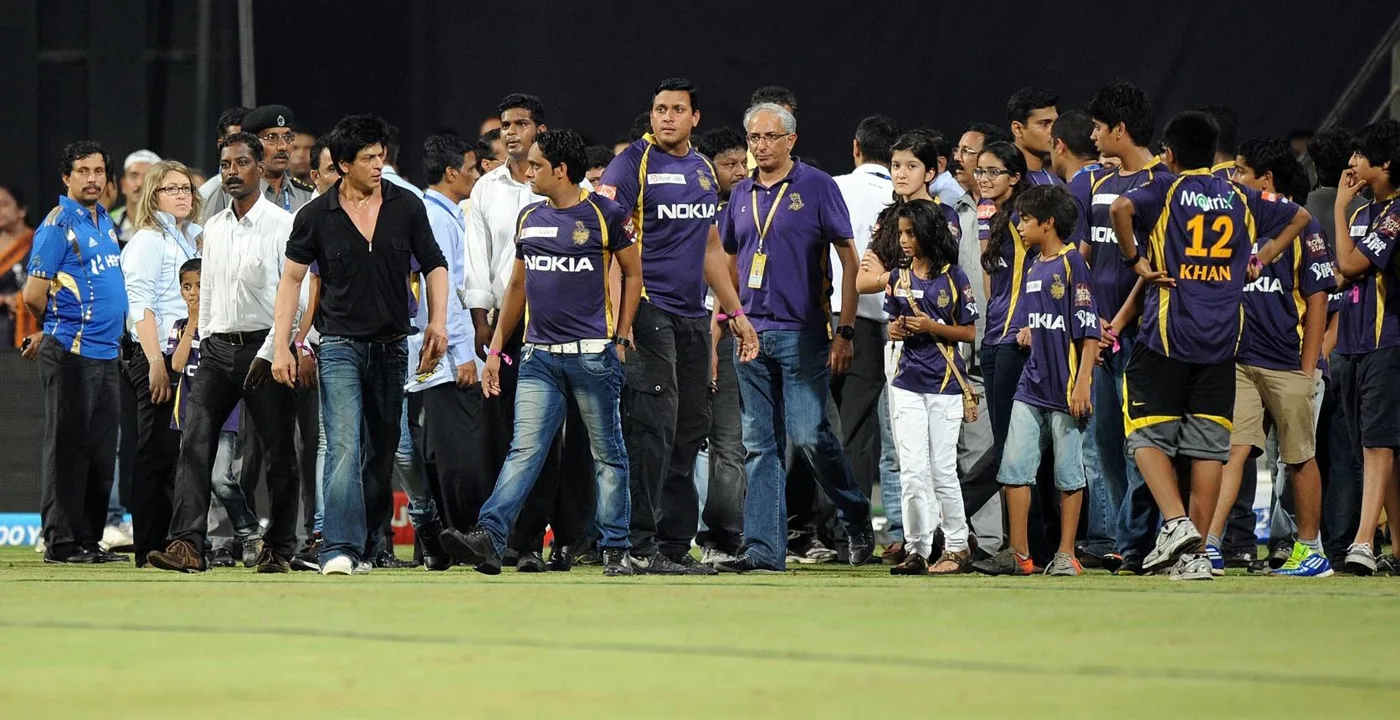
The Kolkata Knight Riders squad, the team he bought at the first IPL auction in 2008. (Image: Final Thesis archive)
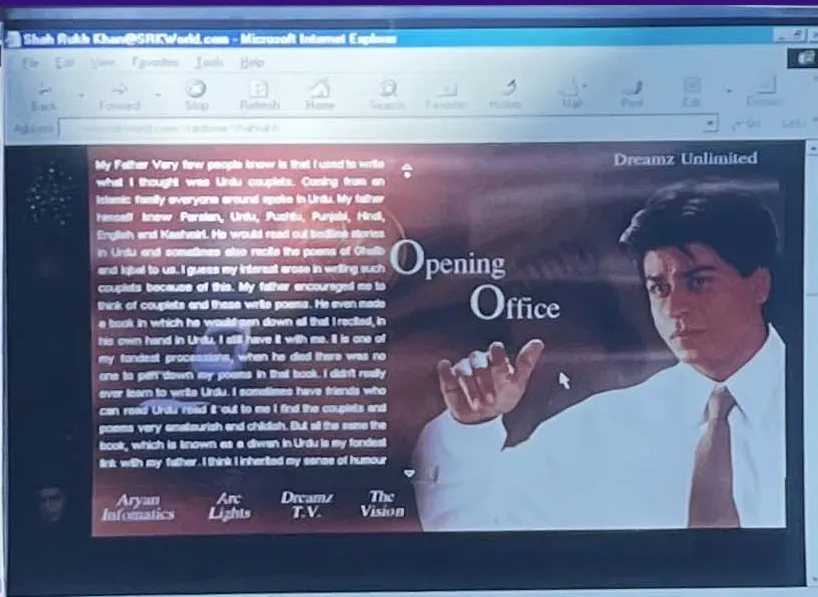
SRKWorld.com, 2000: “Opening Office”, with Dreamz Unlimited, Arc Lights, Dreamz TV and The Vision. (Archive: the author’s collection)
He came out of 2003 with a repaired spine and without his first company. What he did next was to stop being only a star and start building institutions around himself. (Analysis)
A studio of his own. Red Chillies Entertainment, which he and Gauri Khan registered in 2002, absorbed what remained of Dreamz Unlimited, with Gauri Khan as producer. (Fact. Wikipedia: Red Chillies Entertainment) The registry settles the date: Red Chillies Entertainments Private Limited was incorporated in Mumbai on 7 May 2002 (CIN U92130MH2002PTC135790). (Fact. Tofler, from Ministry of Corporate Affairs data) [Unverified] the date Dreamz Unlimited was folded into it; sources give 2003 and 2004. Its first release, Farah Khan’s Main Hoon Na (2004), was a hit. The year’s biggest film was also his, Yash Chopra’s Veer-Zaara, and the third, Swades, in which he played a NASA scientist who comes home to a village without electricity, won him the Filmfare Award for Best Actor. (Fact) By 2004 he was no longer playing one kind of hero. He was playing the country’s idea of itself. (Analysis)
The tools before the hero. In 2006 Red Chillies quietly set up its own visual-effects house, Red Chillies VFX. It would work on Chak De! India and Don, and later on the effects of Ra.One. (Fact. Wikipedia: Red Chillies Entertainment) The company that would one day build a superhero started by building the tools. (Analysis)
The honours and the defeats. The Padma Shri came in 2005. (Fact) In January 2007 he replaced Amitabh Bachchan as the host of Kaun Banega Crorepati for one season of 53 episodes; it averaged about 6.8 TVR against about 14.1 and 11.1 for Bachchan’s first two seasons. (Fact. Wikipedia: Kaun Banega Crorepati) It was a rare public defeat, taken on prime-time television. (Analysis) In April 2007 Madame Tussauds in London unveiled his wax figure; in June France made him an Officier of the Ordre des Arts et des Lettres. (Fact. The Tribune, 4 Apr 2007; Filmibeat, 21 June 2007)
2007: both halves. In Chak De! India he played a disgraced Muslim hockey player who wins back his country by making others win; it brought another Filmfare Best Actor award. (Fact; Analysis) Then on 9 November 2007 came Red Chillies’ own Om Shanti Om: about 2,000 prints worldwide, then the widest release for an Indian film, a tie-in with Amul, and a worldwide gross of about ₹150 crore to ₹152 crore on a ₹40 crore budget. It introduced Deepika Padukone. (Fact. Wikipedia: Om Shanti Om; the two gross figures differ slightly) It opened on the same Friday as Saawariya, the first Hindi film backed by a Hollywood studio, Sony Pictures, and beat it at home. (Fact. Celluloid Junkie, 11 Nov 2007) The star, the producer and the owner of the effects studio were now one person. (Analysis)
20 February 2008: the team. At the first Indian Premier League auction he bought the Kolkata franchise with Juhi Chawla and her husband Jay Mehta for US$75.09 million and named it Kolkata Knight Riders. (Fact. Wikipedia: Kolkata Knight Riders) The partners were familiar: Juhi Chawla from Dreamz Unlimited, Jay Mehta from the SRKWorld launch table. (Fact) On the league’s first night, 18 April 2008, Brendon McCullum made 158 not out off 73 balls and the Knight Riders won by 140 runs. The team finished sixth of eight, and still reported a first-season profit of ₹13 crore. (Fact. Wisden; Wikipedia: 2008 KKR season) A team that lost more than it won made money; the asset was the audience, not the table. (Analysis)
The line someone else opened. On 17 April 2008, the day before the league began, Amitabh Bachchan started a blog and kept it going for more than ten years. (Fact. Gulf News, 5 Nov 2018) The man he had replaced on Kaun Banega Crorepati now had the kind of direct line SRKWorld had been. (Analysis)
2009: the line goes wrong. In the second season, played in South Africa, an anonymous blog called Fake IPL Player posted invented inside stories about his team: 43 posts in four weeks, about 17,000 comments, about 150,000 visitors on one day. The team finished last, with three wins in fourteen matches, and lost all nine games decided in the final over. (Fact. Wisden; ESPNcricinfo) For the first time the internet he had tried to build on in 2000 was talking about him without him. (Analysis) A film can be recut before release. A team loses in public, every night, for six weeks.
In December 2008 Newsweek named him one of the fifty most powerful people in the world and “the world’s biggest movie star”. (Fact. Filmibeat, 23 Dec 2008) He was a star, a studio owner, a team owner, a television host, the face of the country’s second-largest carmaker and a holder of the Padma Shri. He had built everything except the thing he had tried first: his own line to the audience, owned by him and open every day. (Analysis)
Then, on 14 August 2009, immigration officers at Newark airport in New Jersey took him aside and questioned him for over an hour, he said two, because of his name. (Fact. Wikipedia: My Name Is Khan, citing the BBC) His next film was called My Name Is Khan.
The studio’s other calling cards. Between Main Hoon Na and Om Shanti Om, Red Chillies released Paheli on 24 June 2005, produced by Gauri Khan. It was India’s official entry to the 79th Academy Awards, was made for about ₹14 crore and grossed about ₹32 crore worldwide; Shreya Ghoshal’s “Dheere Jalna” won it the National Film Award for Best Female Playback Singer. (Fact. Wikipedia: Paheli) The company’s first film sent to the world was a folk tale from Rajasthan, not an action film. (Analysis)
The audience abroad becomes a market. Karan Johar’s Kabhi Alvida Naa Kehna, released on 11 August 2006 on a budget of ₹50 crore, grossed ₹113 crore worldwide, of which US$10.56 million came from overseas. At the time it was the highest-grossing Indian film in overseas markets. (Fact. Wikipedia: Kabhi Alvida Naa Kehna) The diaspora was no longer a bonus on top of the Indian run; it could set a record on its own. (Analysis)
Back on prime time, 2008. A year after Kaun Banega Crorepati, Star Plus announced on 12 February 2008 that he would host Kya Aap Paanchvi Pass Se Tez Hain?, the Hindi version of Fox’s Are You Smarter Than a 5th Grader?, with a top prize of ₹5 crore against the ₹1 crore of Kaun Banega Crorepati. (Fact. Business Standard, 12 Feb 2008) It premiered on 25 April 2008 and ran for 37 episodes, ending on 27 July 2008. (Fact. Wikipedia: Kya Aap Paanchvi Pass Se Tez Hain?) The two sources name the producer differently: Business Standard gives Synergy Adlabs with Bulldog Media and Entertainment, Wikipedia gives Bulldog Media & Entertainment alone. (Method note) This time the show was his alone, with no predecessor’s ratings to be measured against. (Analysis)
A title settled before release, 2009. Red Chillies’ Billu, directed by Priyadarshan and released on 13 February 2009, was a remake of the 2007 Malayalam film Katha Parayumpol. It began as Billu Barber; salon and beauty-parlour associations in Bandra called the word derogatory, and he dropped “Barber” from the title and the promotions and invited The Hairdressers’ Association of Mumbai to the premiere. Made for ₹27 crore, it grossed an estimated ₹47.45 crore. (Fact. Wikipedia: Billu) As a producer he now met a protest before the release, at the table, rather than after it at the box office. (Analysis)
The money behind the other films, 2004 to 2009. The chapter gives the cost and the gross of the films his own company made. The table below adds six films of these years for which it gives no figures, at least four of them paid for by other studios. (Method note)
| Film | Released | Made by | Budget | Worldwide gross |
|---|---|---|---|---|
| Main Hoon Na | 30 Apr 2004 | Red Chillies Entertainment and Venus Movies | N/A (not stated in the source) | ₹89.7 crore in the infobox; ₹84 crore in the lead text; the box-office section gives ₹48 crore in India plus ₹1.9 crore overseas |
| Veer-Zaara | 12 Nov 2004 (Diwali) | Yash Chopra | ₹26 crore | over ₹105 crore |
| Swades | 17 Dec 2004 | N/A (the source says only that Red Chillies now owns the film) | N/A (not stated in the source) | ₹34.64 crore lifetime; ₹15.25 crore net in India, US$2.79 million overseas |
| Don | 20 Oct 2006 (Diwali) | Excel Entertainment (Ritesh Sidhwani, Farhan Akhtar) | ₹40 crore, production and marketing | over ₹106 crore; over ₹71 crore in India, over US$7.8 million overseas |
| Chak De! India | 10 Aug 2007 | Yash Raj Films (Aditya Chopra) | ₹20 crore | ₹109 crore in the infobox; ₹102 crore in the box-office section; ₹85.86 crore gross in India, US$3.94 million overseas |
| Rab Ne Bana Di Jodi | 12 Dec 2008 | Yash Raj Films | ₹31 crore | about ₹157 crore; the year’s highest-grossing Hindi film overseas |
(Fact. Wikipedia: Main Hoon Na; Wikipedia: Veer-Zaara; Wikipedia: Swades; Wikipedia: Don (2006); Wikipedia: Chak De! India; Wikipedia: Rab Ne Bana Di Jodi, all read 18 Nov 2026. The three Main Hoon Na figures do not agree with each other; all are printed.)
Rab Ne Bana Di Jodi was also the first film of Anushka Sharma, cast as Taani. (Fact. Wikipedia: Rab Ne Bana Di Jodi) Two heroines who made their debuts in these years, Deepika Padukone in 2007 and Anushka Sharma in 2008, began opposite him. (Analysis)
On this book’s arithmetic, gross against reported budget, Chak De! India returned about 5.5 times its cost (5.1 on the lower gross), Rab Ne Bana Di Jodi about 5.1, Veer-Zaara about 4.0 and Don about 2.7, against about 3.8 for Om Shanti Om, 2.3 for Paheli and 1.8 for Billu. This is not profit. (This book’s arithmetic, from the figures in this chapter) The best multiples of these years came from films other studios paid for. His own company’s films earned less on each rupee, and what it bought instead was ownership: the negative, the effects house and the name on the banner. (Analysis)