Part II · The First Digital Empire Starts With…, 2000 to 2013 · 13 of 57
Chapter 11 · The Empire That Almost Was
Put the plan of 2000 beside the campaign of 2011, and the shape of the ambition appears. (Analysis)
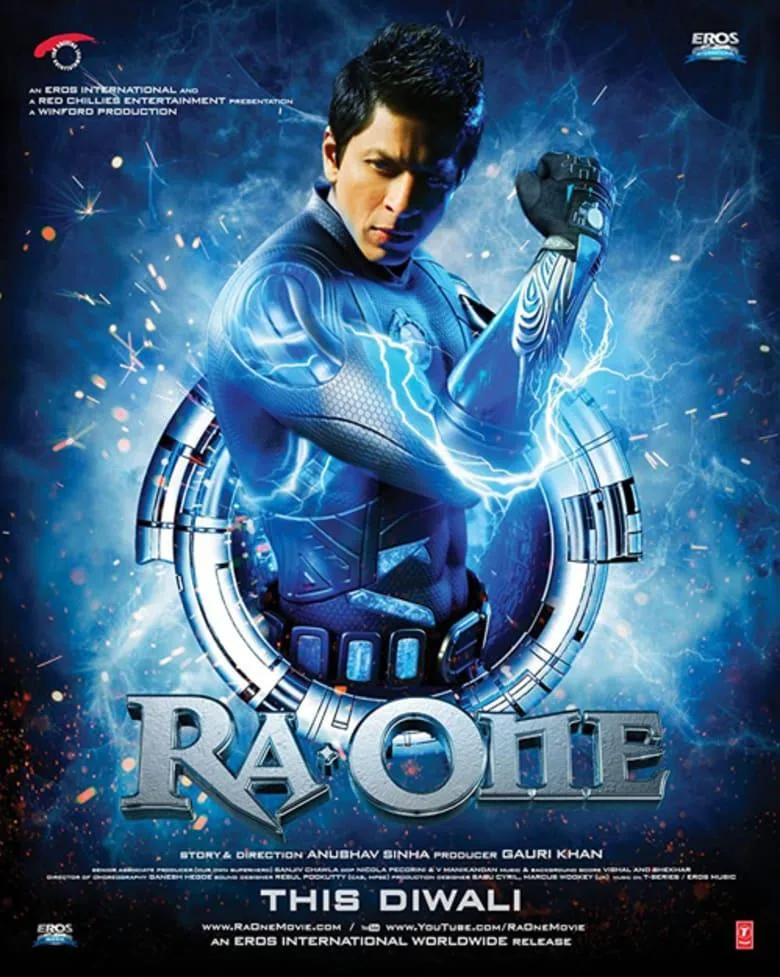
Ra.One (2011): the superhero universe that never got its second chapter. (Image: Final Thesis archive)
| SRKWorld set out to (2000) | What Ra.One delivered (2011) | What never came |
|---|---|---|
| A star’s own portal, open every day | An official site, a YouTube channel, Google+ | A permanent home that outlived the film |
| A second self for the screen: Shah Rock Jaan | A hero who lived online before he lived in cinemas: G.One | A second chapter for the hero |
| A music library, animation and live shows online | A PlayStation game, a social game, a comic | A game that kept being updated, a sequel world |
| Partners from music, technology and broadcasting | More than 25 brands across categories | Rights managed as one universe across years |
| A direct line between the star and the fan | Live video chat with fans | A line the fans could keep open themselves |
(Fact for the first two columns, as sourced in Chapters 6 and 10; the third column is Analysis)
A franchise needs more than a launch. It needs continuity, rights management, investment and, above all, a reason for the audience to keep playing after the credits. Ra.One delivered the launch. The universe never got its second chapter, and SRKWorld, in the form the author says they dreamed of, never came back. (Analysis; Recollection)
2012: a cup, a ban and a farewell. Between the superhero and the train came a year that showed every side of the institution. In May 2012, after the Knight Riders beat Mumbai Indians at the Wankhede, he argued with officials and guards; the Mumbai Cricket Association banned him from the stadium for five years. He said the guards had misbehaved with children, his daughter among them. Eleven days later, on 27 May, the same team won its first IPL title, in Chennai. (Fact. Daily FT, 19 May 2012; ESPNcricinfo) The ban was lifted in August 2015. (Fact. Deccan Chronicle, 2 Aug 2015) On 12 April 2012 he gave Yale’s Chubb Fellowship lecture. (Fact. Yale News) On 21 October Yash Chopra died, before Jab Tak Hai Jaan opened; it grossed about ₹236 crore worldwide. The director of Darr and Dil To Pagal Hai closed his career with him. (Fact. Wikipedia: Jab Tak Hai Jaan; Analysis)
He had won a cup in Chennai and lost a stadium in Mumbai in the same month. His next film would take a train towards the south, and this time the audience would drive. (Analysis)
The richest year without a new universe. The money did not wait for a sequel. In January 2013 Forbes India published its first Celebrity 100 list, ranked by income and popularity, and put him first: about ₹202.8 crore earned between October 2011 and September 2012, the window that opened with Ra.One. Salman Khan was second with about ₹144.2 crore and M.S. Dhoni third with about ₹135.16 crore. (Fact. Koimoi, 24 Jan 2013) The figure is a Forbes India estimate, not a published account. (Method note)
The Diwali screens fight. Jab Tak Hai Jaan opened on 13 November 2012, on Diwali, against Ajay Devgn’s Son of Sardaar. (Fact. Bollywood Hungama, 15 Nov 2013) Ajay Devgn Films complained to the Competition Commission of India that Yash Raj Films had tied exhibitors: Ek Tha Tiger only if they also took Jab Tak Hai Jaan for Diwali. The same report said his previous film had opened on 1,200 screens and he was struggling to secure 400. (Fact. Sunday Times, 11 Nov 2012) The Commission found no antitrust violation, and on 13 November 2013 the Competition Appellate Tribunal dismissed the appeal. (Fact. PYMNTS/CPI, 6 Nov 2012; Bollywood Hungama, 15 Nov 2013) The lesson for a fan franchise is plain: in 2012 the screens, not the fans, still decided how many people could see a film on its first weekend. (Analysis)
The part of the empire that did survive. What outlived Ra.One was the workshop behind it. Red Chillies VFX, founded in 2006, went on to lead the effects of another studio’s superhero, Rakesh Roshan’s Krrish 3 (2013), with Pixion also contributing; Cartoon Brew put the film’s effects cost at $3.9 million. (Fact. Cartoon Brew, 15 Jan 2017; VFX Voice, 2 Oct 2017) VFX Voice names Ra.One and Krrish 3 as the films that first won the house recognition. (Fact. VFX Voice, 2 Oct 2017) The universe had no second chapter, but the skill built for it became a business that sold to the rest of the industry. (Analysis)
The small screen, three months later. Ra.One reached television on 21 January 2012, on Star Gold, three months after its cinema release. (Fact. exchange4media, 23 Jan 2012) Its premiere rated 6.7, below the channel’s own premieres of Bodyguard (10) and Singham (8.7). (Fact. exchange4media, 28 Feb 2013) A forum copy of an Indiantelevision report gives the same 6.7 with a 28 per cent market share, a 9 pm slot, and Dabangg (9.2, Colors) and 3 Idiots (10.88, Set) as the records it did not break. (Fact. DreamDTH, citing Indiantelevision, 2012) The first report calls the figure a TRP, the second a TVR; the number is the same. (Method note)
| TV premiere | Channel | Rating |
|---|---|---|
| 3 Idiots | Set | 10.88 |
| Bodyguard | Star Gold | 10 |
| Dabangg | Colors | 9.2 |
| Singham | Star Gold | 8.7 |
| Ra.One | Star Gold | 6.7 |
(Fact. exchange4media, 28 Feb 2013; DreamDTH, citing Indiantelevision)
The superhero next door got its sequels. The film whose effects Red Chillies VFX led belonged to a family that kept going. Rakesh Roshan’s series began with Koi… Mil Gaya (2003), continued with Krrish (2006) and Krrish 3 (2013). (Fact. ThePrint/ANI, 28 Mar 2025) The Numbers counts Krrish 3 at $43,337,264 worldwide, $41,213,931 of it outside the United States. (Fact. The Numbers) On 28 March 2025 Rakesh Roshan announced Krrish 4, with Hrithik Roshan directing and starring, produced by Yash Raj Films with him. (Fact. ThePrint/ANI, 28 Mar 2025)
The two superheroes were built by the same effects house within two years of each other. One stayed a single film; the other became four, owned by a family that treated it as a series from the start. The difference was not technology. It was the decision to keep making chapters. (Analysis)
The television arm that came and went. The empire also had a small-screen wing. In May 2008, while hosting a Star Plus quiz show, he said his production house would make television under the name Red Chili Idiot Box: short fiction he called “light movies of short duration”, modelled on HBO’s short-film mini-series, with work to start within three or four months. He asked friends in the television industry to help, since his team had no television experience. (Fact. Filmibeat, 7 May 2008) In July 2008 Business Standard reported that Red Chillies would produce shows for the lifestyle channel E24 of BAG Films & Media, and that he and Gauri Khan had bought a 10 per cent stake in its arm BAG Glamour the year before, in their personal capacity; BAG’s chairman declined to comment. (Fact. Business Standard, 11 Jul 2008)
By January 2009 the division had its name, Idiot Box, and a brief: shows for general-entertainment and lifestyle channels, with the former film journalist Samar Khan tipped to run it. Its first show was The First Ladies with Abu Sandeep on NDTV Good Times, with Nita Ambani in the first episode; a sitcom, Ghar Ki Baat, was next, for NDTV Imagine. (Fact. Business Today, 8 Jan 2009) That report gave no budgets and no ratings, so the arm’s results are N/A here. (Method note)
Wikipedia’s page on Red Chillies Entertainment dates the launch of Red Chillies Idiot Box to 2009 and says it made 10 shows, 2 television films and one theatrical film, Men Will Be Men, before it was shut down in 2012. (Fact, as reported. Wikipedia: Red Chillies Entertainment) [Unverified] This edition found no dated report of the closure or of the show count; Red Chillies’ filings with the Registrar of Companies, or a trade report of the time, would settle both. (Method note)
If that account is right, the television wing closed in 2012, the year after Ra.One, while the effects workshop kept selling its skill to other studios. Of the three new arms of those years, the film’s universe, the TV unit and the VFX house, only the one that served other people’s projects lasted. (Analysis)
The one film the television arm made. The theatrical film in that count reached cinemas six months before Ra.One. Men Will Be Men opened on 29 April 2011, distributed by PVR Pictures. (Fact. Wikipedia: Men Will Be Men) Its first-time director, Gorky, had spent five years as an assistant to Kundan Shah; the IANS wire report said it was shot in seven days on a budget of about ₹1 crore and released with 75 prints, in India only, with Samar Khan of Red Chillies Idiot Box as line producer. (Fact. NowRunning/IANS, 26 Apr 2011) Bollywood Hungama gave its length as 76 minutes, said it was presented by Seagram’s Imperial Blue, whose tagline gave the film its title, and said he had not promoted it at all. (Fact. Bollywood Hungama, 28 Apr 2011) Wikipedia estimates its takings at ₹19 lakh. (Fact, as reported. Wikipedia: Men Will Be Men)
The sources name the banner three ways: Bollywood Hungama says “Idiot Box Film”, the IANS report says Red Chillies Idiot Box, and Wikipedia’s infobox says Red Chillies Idiot Box while its text says Red Chillies Entertainment. All three are printed here because they disagree. (Method note) The 2011 reports confirm that the film existed and came from the television arm; they do not settle the show count or the 2012 closure, which stay [Unverified] above. (Method note) In one year the same house sent out a brand-sponsored comedy with no star and no campaign, and the most promoted film of his career. (Analysis)
The workshop’s next order. Two years after Ra.One, the effects house delivered 1,500 visual-effects shots for Chennai Express (2013). (Fact. AnimationXpress, 1 Oct 2013) The same report named Keitan Yadav as chief operating officer, Haresh (Harry) Hingorani as chief creative officer and Puran Gurung as VFX supervisor. Some 4K shots with water and vegetation took 10 to 15 hours to render per frame; about 70 per cent of the greenery in the waterfall sequence was rebuilt in CGI over about two months; the footage of the village held 30 per cent of its houses and the rest were built in the computer. (Fact. AnimationXpress, 1 Oct 2013)
No source read for this edition gives the house’s headcount, revenue or a named list of outside clients, so those are N/A here. A 2026 profile says it has worked on a wide range of films beyond Red Chillies’ own, without naming them. (Method note; Fact. Eastern Eye, 1 Apr 2026) The pattern holds: the superhero’s universe stopped at one film, but the people who drew it were, two years later, filling a train film with 1,500 shots. (Analysis)