Part VIII · KING: The Royal Flush · 43 of 57
Chapter 41 · FAN Becomes the Fire
The official campaign has barely started. The fans are already running it. (Analysis)

KING Buzz. (The campaign's art, agarmainkinghota.com)
| Measure (the campaign’s KING Buzz tracker) | 4 Oct 2026 (baseline) | 5 Oct 2026 |
|---|---|---|
| Observable KING posts | 699,000 | 742,400 |
| Views across tracked KING videos | 31.18 million | 38.72 million |
| Views on the top KING video | 12.97 million | 16.21 million |
(Fact: the campaign’s KING Buzz daily ledger, against the locked 4 October 2026 baseline. Posts are not people; views are not unique fans.) In one day, 43,400 new posts and about 7.5 million new views, with no official campaign behind them. (Fact, arithmetic)
(Proposal) In the proposed model the fan is no longer only the audience or the consumer. Fans become storytellers, meme-makers, game creators, campaign designers and the distributors of the universe. The pawn lights the fire; the fan is the fire. In 1995 an audience kept a film running at one Mumbai cinema for a quarter of a century. In 2013 it moved a train. In 2026 it can build the world. (Analysis)
From the Final Thesis
Added from the Final Thesis, word for word. Where a figure here differs from the sourced figure earlier in this chapter, the chapter’s figure stands; see Addendum B.
The fan-powered dimension
The second dimension is the possibility of a participatory campaign.
This is where the history of Ra.One and Chennai Express becomes especially relevant.
The earlier campaigns established that a film could extend into gaming, character merchandise, interactive content, fan participation and shared digital experiences.
A contemporary fan platform could take those principles further.
The following is a proposed campaign architecture, informed by the historical case studies and Gupta’s stated creative direction. It is not a description of an announced official KING campaign.
(Final Thesis, section 25)
KING FAN ARENA: O TO X — MY MATH
A fan-powered storytelling system inspired by the principles of Chennai Express and the open-source entertainment model.
- The story builder. Fans build stories through a structured system for duos, trios and expandable ensembles. Each participant can add original ideas, characters, dialogue and story developments.
- KING EXPRESS. A fan-powered journey in which collective creative milestones advance a virtual train, unlock new prompts and reveal additional chapters or challenges.
- The AI bioscope. A storytelling and storyboard environment where fans can experiment with original scenarios, visual concepts, narrative branches and shareable creations.
- The fan franchise. A framework for fan clubs to collaborate, build original creative work, participate in challenges and share community achievements.
The central proposition is simple:
Fans do not have to wait for the next piece of promotional content.
They can help create the surrounding experience.
That is a natural evolution of the Chennai Express principle. Instead of a virtual train moved by tweets alone, the journey could advance through collaborative stories, challenges, original art and fan-created milestones.
It would be a campaign that treats fans as creative participants while preserving a clear distinction between official film material and original fan contributions.
A local prototype could demonstrate the story builder, storyboard, fan challenges and exportable creative work. A live global community would require additional infrastructure for accounts, moderation, rights management, shared data and community operations.
This is an actionable concept—not evidence that the film’s producers have adopted it.
(Final Thesis, section 25)
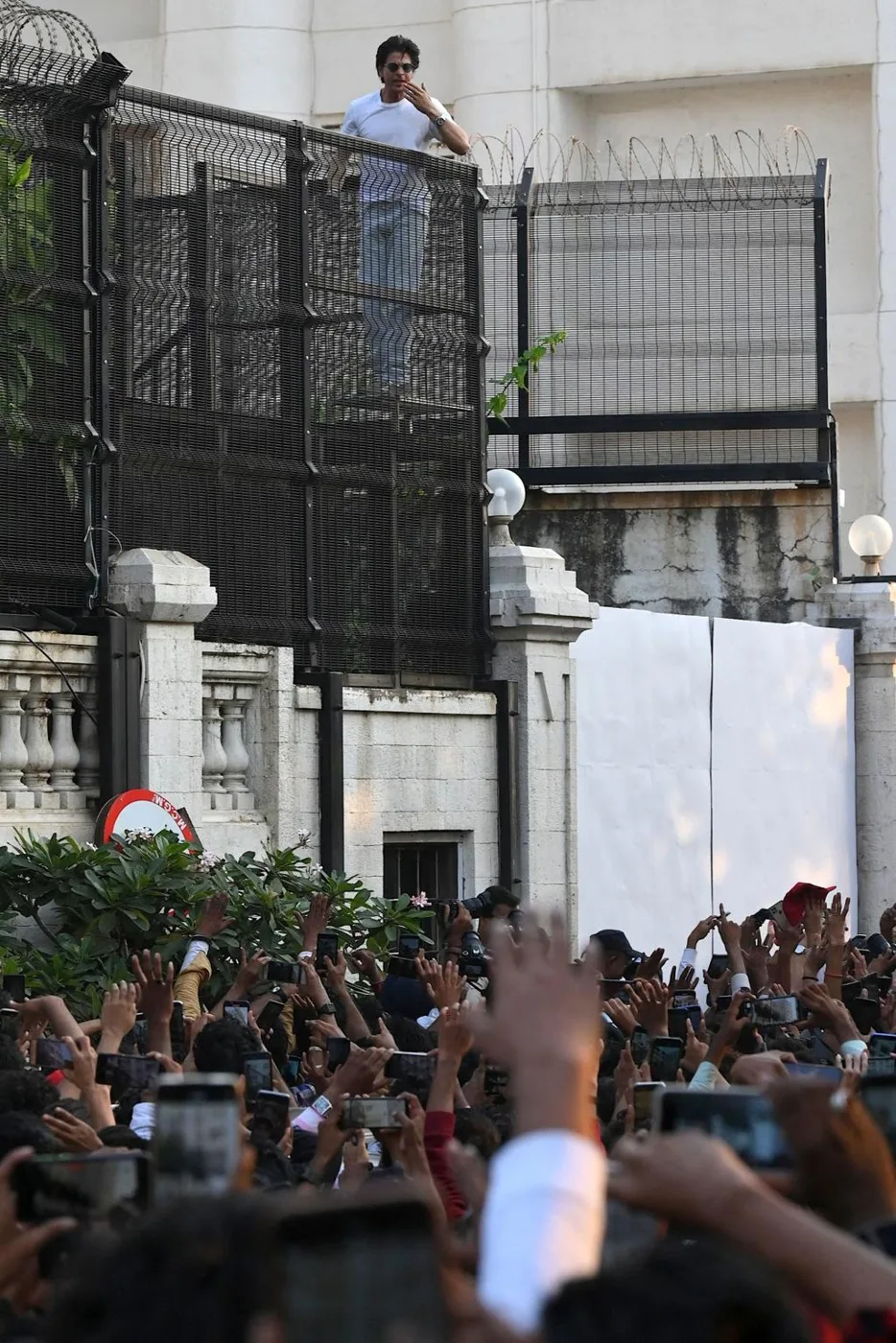
Fans at the gate on his birthday. (Image: Final Thesis archive)
From marketing a film to building a relationship
The historical case offers a useful way to distinguish three models of entertainment marketing.
| Model | Primary asset | Primary activity | Potential measure |
|---|---|---|---|
| Campaign-led marketing | The upcoming film | Advertising, publicity, trailers and release promotion | Reach, engagement, ticket sales |
| Ecosystem-led marketing | The film and its associated intellectual property | Games, merchandise, characters, digital extensions and partnerships | Participation, licensing, ancillary revenue |
| Participatory entertainment | The film, its intellectual property and the audience’s creative activity | Fan creation, interactive experiences, community events and licensed participation | Repeat participation, original contributions, creator value and commercial conversion |
The first two models have historical examples in the Ra.One and Chennai Express campaigns.
The third is a proposed framework.
The difference is not simply that the third model uses AI.
It changes the role of the audience.
In a conventional campaign, the audience receives and responds to promotional material.
In a participatory model, the audience may contribute original work, collaborate with others, play, compete, organise or create within an agreed framework.
That requires technology, but also governance, rights, consent and trust.
(Final Thesis, section 68)
Proposition 1 — Digital campaigns can create assets beyond attention.
The Ra.One record demonstrates the use of character guides, merchandise, games and publishing. Further research could establish which assets retained value after the theatrical campaign ended.
(Final Thesis, section 68)
Proposition 2 — Analytics and creative participation are different capabilities.
Chennai Express provides evidence of large-scale social-media measurement. A future system would need to measure not only attention but also original participation and repeat engagement.
(Final Thesis, section 68)
Proposition 5 — AI could lower the cost of participation, but rights determine sustainability.
Interactive media could expand the range of creative experiences available to audiences. The model’s viability depends on consent, attribution, licensing, privacy and fair treatment of creators.
These propositions make the case study useful to marketers, media companies, researchers, technology businesses and intellectual-property owners.
They also create a research agenda that can be tested beyond the Shah Rukh Khan case.
(Final Thesis, section 68)