Asoka to Boo-Da · 57 of 57
The Final Frame · The Silence Before the King
The closing reflection. The responsibility beyond cinema.
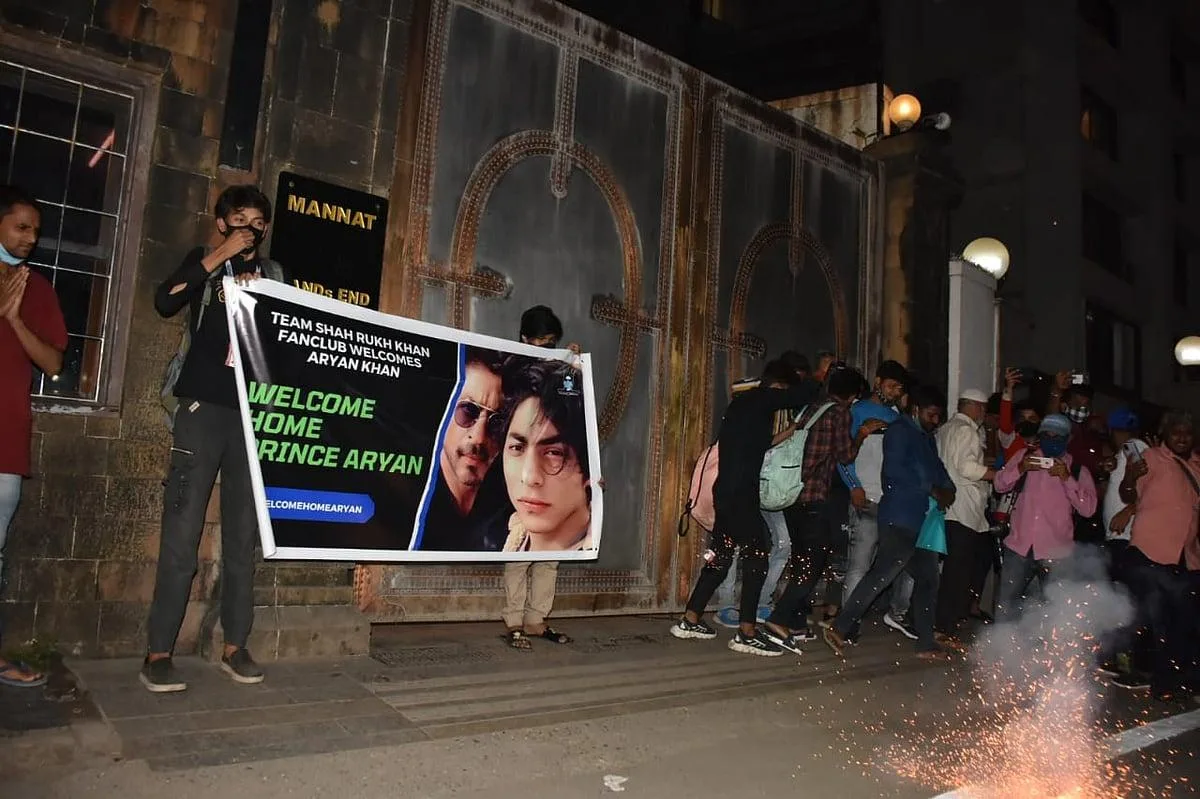
Fans celebrate outside Mannat, 30 October 2021. (Image: Final Thesis archive)
We helped build the campaigns. A billion impressions did not tweet themselves. Twenty-five fan clubs spoke with one voice in 2013. A Mumbai audience kept one film running for a quarter of a century. The fans built the King’s digital world as much as any studio did.
We watched the comeback. In 2023 the community filled the cinemas, the streets and the timelines, and carried three films to about ₹2,669 crore. We celebrated the resurrection as if it were our own.
We saw the King return. But what did October 2021 teach us about the difference between celebrating a star and standing by a human being? On the day the question was asked of us, by the author’s account, the road outside his gate was quiet.
But did we ever build the kingdom? A fan base is a crowd that gathers for a birthday. A community is one that stands for dignity, fairness and humanity when there is nothing to celebrate. The first we have proved, every 2 November, for thirty years. The second we have not yet tried.
KING: the Royal Flush yet to be played. Can the love for one extraordinary entertainer become a lasting force for creativity, solidarity and social responsibility? The cards are on the table. The hand is still to be played, and this time some of the cards are ours.
The man who once made fans move a train to unlock a trailer has returned to the top of the box office, built an empire beyond the screen, and put his money into the next technology. We know what he has done. We know what he has built. What we do not know is what he will do next.
KING arrives on 24 December 2026. The answers, if there are any, are still to come.
We cannot rewrite the silence of the past. But we can decide what kind of community we build for the future.
Picture abhi baaki hain.
From the Final Thesis
Added from the Final Thesis, word for word. Where a figure here differs from the sourced figure earlier in this chapter, the chapter’s figure stands; see Addendum B.
EPILOGUE — THE KING HAS NOT ANSWERED
The story began with a superhero.
It continued with a train.
Then came a period in which the digital revolution seemed to lose its momentum.
ZERO.
A silence.
A family crisis that, in Gupta’s account, became the straw that broke the camel’s back.
Then three films that brought the King back to the centre of the cinematic universe.
Pathaan.
Jawan.
Dunki.
And now KING.
But perhaps the most intriguing question is not whether Shah Rukh Khan can make another blockbuster.
It is whether he will return to the unfinished experiment that began with Ra.One and found one of its clearest expressions in Chennai Express.
Will the digital revolution remain a series of exceptional campaigns, each reinvented for a new release?
Or could the next chapter connect cinema, AI, sports, technology and fan communities into a continuing entertainment ecosystem?
Will the King simply conquer the box office again?
Or will he change the rules by which the kingdom operates?
The evidence establishes the historical innovations, the later campaign patterns, the 2021 crisis, the 2023 cinematic return, the international business expansion and the AI investment connection.
It does not establish a secret plan for KING.
That uncertainty is not a defect in the story. It is the reason the story remains worth following.
And so we return to the satire.
ASOKA TO BOODA.
Be Da Boo-Da.
The conqueror becomes the observer. The empire becomes the question. The King steps away from the old game, only to return when the rules of the game may be changing.
Is the apparent silence a pause?
Is it a recalibration?
Is it simply the quiet before another film release?
Or is the man who once attempted to make Bollywood interactive preparing to revisit that ambition in an age when every fan can become a storyteller?
What’s Mr. Khan cooking?
What’s he up to?
What’s this silence?
What storm is brewing?
The curtain has not risen.
The King has not answered.
And perhaps, after all these years, the most interesting thing about KING is not what we know.
It is what we are still waiting to discover.
(Final Thesis, section 39)
EPILOGUE — WHAT IS MR. KHAN COOKING?
Return, for a moment, to 4 October 2021.
To the silence outside Mannat as Gupta remembers it.
To the question that followed: if not for Shah Rukh Khan, then for whom will the largest democracy in the world stand behind?
The years since have brought a cinematic return on a scale few performers have experienced, a global sports expansion, continuing commercial growth, and a documented investment connection to a company developing interactive AI content.
They have also brought KING.
The public facts tell us that the film is coming. They tell us about its director, its announced release and the wider business activities of its star.
They do not tell us what Shah Rukh Khan is privately planning.
They do not tell us whether SRKWORLD will return, whether the next fan campaign will revisit the participatory ambition of Chennai Express, or whether KING will introduce a new model of AI-driven storytelling.
Those are the questions that make the next chapter interesting.
Perhaps KING will be a film whose entire meaning lies within the story told on screen.
Perhaps it will also become the starting point for a wider entertainment experience.
Perhaps the most important development will have nothing to do with AI or technology at all.
The evidence has yet to answer those questions.
But there is a remarkable symmetry in the history.
In 2011, G.ONE suggested that an Indian film character could live beyond the screen.
In 2013, the Chennai Express campaign showed how fans could move a story forward through collective participation.
In 2018, ZERO closed one phase of the theatrical journey.
In 2021, 4 October became, in Gupta’s account, the moment when the meaning of public silence changed.
In 2023, Pathaan, Jawan and Dunki brought Shah Rukh Khan back to the centre of the cinematic conversation.
By 2026, the Knight Riders had expanded into international sports infrastructure, and Khan had publicly participated in an AI-content company’s funding round.
And now, a film called KING.
The question is no longer merely whether Shah Rukh Khan can command an audience.
He has already demonstrated that across cinema, sport and global entertainment.
The question is whether the next chapter can bring together the creative, technological and participatory ambitions that have appeared at different points throughout his career.
Whether a fan can become a storyteller.
Whether a film can become a platform.
Whether the unfinished ideas of an earlier digital era can find a new expression in the age of AI.
And whether the silence outside Mannat, as remembered by Gupta, will remain simply a painful moment in the history of celebrity—or become the starting point for a deeper conversation about fandom, solidarity and the responsibilities of a society towards the people it celebrates.
What is Mr. Khan up to?
What’s this silence?
What storm is brewing?
The public record does not yet answer.
And that is precisely where the story of KING begins.
(Final Thesis, section 27)
From a virtual train to a global empire. From ZERO to a resurrection. And now, a film called KING.
The evidence assembled across 2010–2026 supports a broader conclusion than a conventional celebrity comeback story.
Shah Rukh Khan’s career offers a case study in the changing relationship between cinema, technology, intellectual property, fandom and global business.
Three transformations stand out.
From My Name Is Khan’s global promotional reach to Ra.One’s character ecosystem and Chennai Express’s fan participation, the public record documents a sustained period of digital experimentation.
The 2021 Aryan Khan case became a major public event involving a celebrity family, legal proceedings, media scrutiny and competing narratives of solidarity. Gupta identifies 4 October as the moment that fundamentally changed the meaning of the story.
The subsequent cinematic releases, international sports expansion, technology investment and continuing fan engagement create a new context for examining KING—not as proof of a secret plan, but as an opportunity to ask what a modern entertainment franchise could become.
The strongest conclusion is not that every event since 2021 was planned, nor that every business development is connected to a single personal mission.
It is that the public record presents an unusually rich convergence of cultural influence, digital experimentation, commercial expansion and audience loyalty.
And that convergence deserves to be studied as more than a succession of box-office headlines.
(Final Thesis, section 26)