Part I · The Origin of the King, 1965 to 1999 · 3 of 57
Chapter 1 · Diaper Days: the boy in the wings, 1946 to 1975
How a boy from Delhi, with no film family and no money, reached the whole country through one television channel and became the romantic hero of a nation that was just learning to buy things. Facts in this Part are from Wikipedia: Shah Rukh Khan unless another source is named.
[image: SRKWorld.com, 2000: Diaper Days]
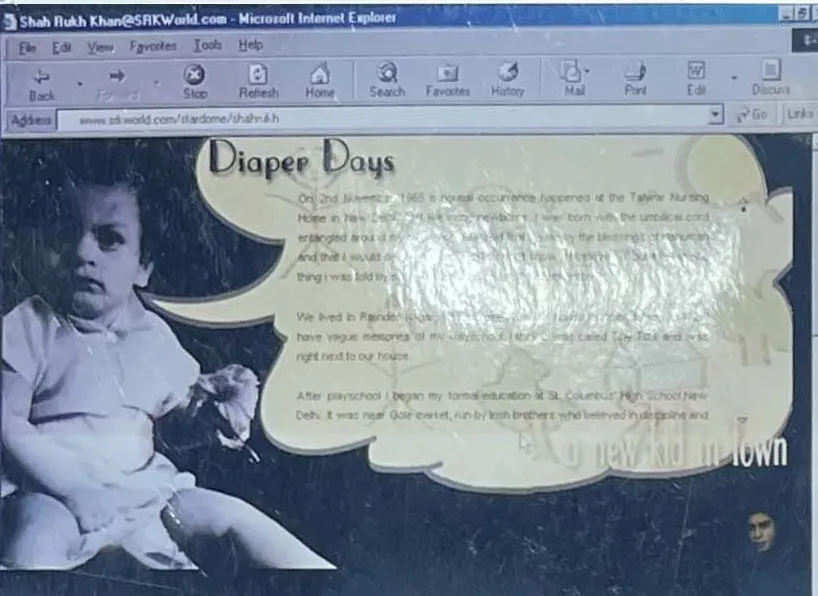
SRKWorld.com, 2000: “Diaper Days”. (Archive: the author’s collection)
The story starts a year before India does. In 1946 a young man from Peshawar, Mir Taj Mohammed Khan, came to Delhi to study law. He was about nineteen and had already been to jail: arrested during the Quit India movement of 1942, he was in and out of prison for the next two years. He had campaigned with the Khudai Khidmatgar, the non-violent movement of Abdul Ghaffar Khan, the “Frontier Gandhi”. (Fact. Alt News, 29 Oct 2021, citing his gravestone, which gives his birth as 27 October 1927, and the biographies King of Bollywood and Shahrukh Khan: The Story of the Man*)* Partition came the next year. Peshawar went to Pakistan. He stayed in Delhi. (Fact)
Hold on to that inheritance. The son of a man who went to prison for non-violent resistance will, seventy-five years later, stand at his own gate in silence. (Analysis)
The ballot of 1957. The election archive IndiaVotes lists three candidates for the Gurgaon seat in the 1957 Lok Sabha election: Maulana Abul Kalam Azad of the Congress, who won with 191,221 votes; Mool Chand of the Bharatiya Jana Sangh, with 95,553; and an independent named Taj Mohammad, for whom it records no votes. (Fact. IndiaVotes: Gurgaon, 1957) Several reports identify that independent as Shah Rukh Khan’s father. (Fact. NewsBytes) [Unverified] that the Taj Mohammad on the ballot is Mir Taj Mohammed Khan, and his true vote count; the Election Commission’s statistical report for 1957 would settle both. If the reports are right, a Peshawar-born lawyer of about thirty, with no party behind him, put his name on the same ballot as India’s first education minister. (Analysis)
Two families. In 1959 he married Lateef Fatima, a magistrate and the daughter of Iftikhar Ahmed, chief engineer of the port at Mangalore. Their daughter, Shahnaz Lalarukh, was born in 1960. Their son was born in New Delhi on 2 November 1965, six weeks after the ceasefire that ended India’s second war with Pakistan, and spent his first five years on the Karnataka coast, at his grandfather’s. (Fact) He has described himself as Hyderabadi on his mother’s side, half Pathan on his father’s and partly Kashmiri through his grandmother; his father’s cousins in Peshawar say the family speaks Hindko and came from Kashmir. The accounts do not fully agree, and this book prints them side by side. (Fact) What they share is the shape of the man: a north-western father, a southern mother, a Delhi childhood and, later, a Mumbai career. He would sell that shape to the whole country as an idea of India. (Analysis)
The boy in the wings. The father did not practise law for long. He ran several businesses, including a restaurant, and the family lived in rented flats in Rajendra Nagar. (Fact) A 2026 report names the restaurant as Khatir and says the father also ran the mess at the National School of Drama. (Fact. The Siasat Daily, 22 June 2026) [Unverified] the restaurant’s name and the NSD contract, which need an NSD record or a family statement. The son has said he went to the drama school every day after school, waiting for his sister, and grew up among its actors. The actor Pankaj Kapur, a student there in the mid-1970s, remembers a boy of about ten carrying samosas to the actors at the interval. The boy was Shah Rukh Khan. (Fact. Times of India interview, 2014, and Pankaj Kapur on Kindle Cast, both as reported by The Siasat Daily)
Before he ever saw a film set, he grew up at the back of India’s national drama school, serving the people on stage. The boy who carried food in the interval became the man whom crowds wait for at his gate. (Analysis)
His own word for it. In 2000 he gave his childhood a room on his own website and called it Diaper Days: a baby photograph and a first-person account of a Delhi birth. The title is his joke. (Recollection; archive: SRKWorld screen photographs, 2000)
The house in Shah Wali Qatal. The family he left behind in 1946 stayed where it was. Before he moved to Delhi, Taj Mohammad lived in Shah Wali Qatal, a mohalla near the Qissa Khwani Bazaar in Peshawar’s old walled city, and in 2005 his nephew Mansoor Ahmad still lived there. Mansoor’s father, Ghulam Mohammad, known as Gama, was Taj Mohammad’s elder brother; the cousins told Dawn that the two brothers were arrested and jailed together in 1943-44 for taking part in the freedom movement, and that the family were traders, with no one in films before Shah Rukh. (Fact. Dawn, 26 July 2005) A 2016 report found his cousins, uncles and great-aunts still living in the ancestral home. (Fact. Scroll.in, 5 Feb 2016)
Two visits, two counts. The Peshawar cousins date his visits to the city as a schoolboy in 1978 and again in 1980, when he stayed about a month; a 2020 report says only that he went twice as a child, with his parents. The two accounts agree on the number and this book prints both. (Fact. Dawn, 26 July 2005; Khaleej Times, 29 Jan 2020) The cousins also said he understands Hindko and likes speaking it, though not fluently. (Fact. Dawn, 26 July 2005)
The cousin who crossed back. Mansoor’s sister, Noor Jehan, made the journey the other way. She stayed with Shah Rukh in India for about two and a half months in 1997 and met him again in 2011. (Fact. Dawn, 26 July 2005; Khaleej Times, 29 Jan 2020) She became a district and town councillor in Peshawar, filed papers for the provincial seat PK-77 in 2018 and withdrew at the last moment, and died of cancer in January 2020, aged 52. (Fact. Khaleej Times, 29 Jan 2020) So the ballot ran in the family on both sides of the border: the father on an independent ticket in Gurgaon in 1957, the niece in Peshawar six decades later. (Analysis)
The general at the wedding. The marriage of 1959 had a famous host. Shah Nawaz Khan, born in 1914 in the Rawalpindi district, was one of the three Indian National Army officers tried at the Red Fort with Prem Kumar Sahgal and Gurbaksh Singh Dhillon; on 3 January 1946 all three were found guilty and sentenced to transportation. (Fact. The Better India, 3 Feb 2020; Asianet Newsable, 18 Sep 2025) He then went into politics: he won Meerut in the first Lok Sabha election of 1952, served as a deputy minister for railways and later in other ministries, and in 1956 chaired the committee on Subhas Chandra Bose’s death. (Fact. The Better India, 3 Feb 2020)
How a road accident made a family. In the late 1940s Lateef Fatima was hurt in a road accident in New Delhi while travelling with her parents and sister; Shah Nawaz Khan was nearby and took them to hospital, and afterwards treated her as his own daughter. Meer Taj Mohammed Khan and Lateef Fatima were married in Delhi in 1959 at his bungalow. (Fact. Cinestaan, Mayur Lookhar, 22 July 2017) As children, Shah Rukh and Shahnaz visited the general’s family, especially on Eid; Shah Nawaz Khan died on 9 December 1983, and the two families drifted apart after the mother’s death. (Fact. same source) [Unverified] that he formally adopted Lateef Fatima: some reports say so, Cinestaan calls it unconfirmed, and a family statement or an adoption record would settle it. (Method note)
So the boy of Chapter 1 had two freedom-fighter elders, not one: a father jailed for the non-violent Khudai Khidmatgar, and a godfather tried for treason for an armed army. Both men then tried the ballot box, one as an independent who lost, the other as a minister who won. (Analysis)
Harbour House, Panambur. The southern half of the childhood has an address. In 2013 officers of the New Mangalore Port said Ifthikar Ahmed came to the Mangalore Harbour Project after working on the Sharavathi Dam in Shimoga, served there from 1963 to 1967 as the port’s first chief, and lived in Harbour House on the port premises at Panambur, where his infant grandson stayed. The port called the house the actor’s childhood home and said it hoped he would come back to see it. (Fact. Arab News, 26 Aug 2013) A 2026 report says he spent his first five years in Mangaluru in his maternal grandmother’s care, and that his mother spoke Kannada fluently. (Fact. Coastal Digest, 23 June 2026) The two accounts do not sit together: a posting that ended in 1967 and a stay that ran to about 1970. This book prints both. [Unverified] the grandfather’s years at the port and whether the boy stayed in Mangalore after 1967; the New Mangalore Port’s service records or a family statement would settle it. (Method note)
The mother’s side. Lateef Fatima was born on 1 July 1941 and grew up in Tolichowki, Hyderabad, according to a 2022 report. (Fact. SheThePeople, Ritika Joshi, 7 July 2022) Her son’s post of 1 July 2015, which said she would have been 74 that day, fits the date. (Fact. Deccan Chronicle, 1 July 2015) If it is right, she was about eighteen at the 1959 wedding and Meer Taj Mohammed Khan was some eleven years older, the gap a 2026 report also gives. (Analysis; News24, Aastha Sharma, 18 July 2026) Both reports describe her as a social worker; SheThePeople adds that she studied at Oxford, became a first-class magistrate and was a close associate of Indira Gandhi. [Unverified] the Oxford study and the closeness to Indira Gandhi, which rest on these reports alone; a university record and a dated, sourced photograph would settle them. (Method note) The same News24 report names her father as Shahnawaz Khan, folding the general of the wedding into the port engineer; this book keeps Iftikhar Ahmed as her father and Shah Nawaz Khan as her guardian, as the sources above give them. (Method note)
Back to Kudla. On 25 June 2026 he went back to the city of his first home, for a Rohan Corporation evening at Adyar Garden that launched Marina One, a sea-facing residential project near Surathkal. He greeted the crowd in Tulu and told it: “Mangaluru is the city where I spent part of my childhood.” He added that he recalled little of those days. (Fact. Oneindia, Prakash KL, 26 June 2026; Outlook, 26 June 2026) The boy who left the port about 1970 came back some fifty-six years later as the face of a property launch: the Business of Being SRK (Chapter 31) staged in the town where his story began. (Analysis)