Asoka to Boo-Da · 2 of 57
Prologue · If Not for Shah Rukh Khan
The sentence came first, before the chapters, before the charts, before anyone thought of calling this a thesis. It was written the way people speak when the door is shut and nobody is quoting them:
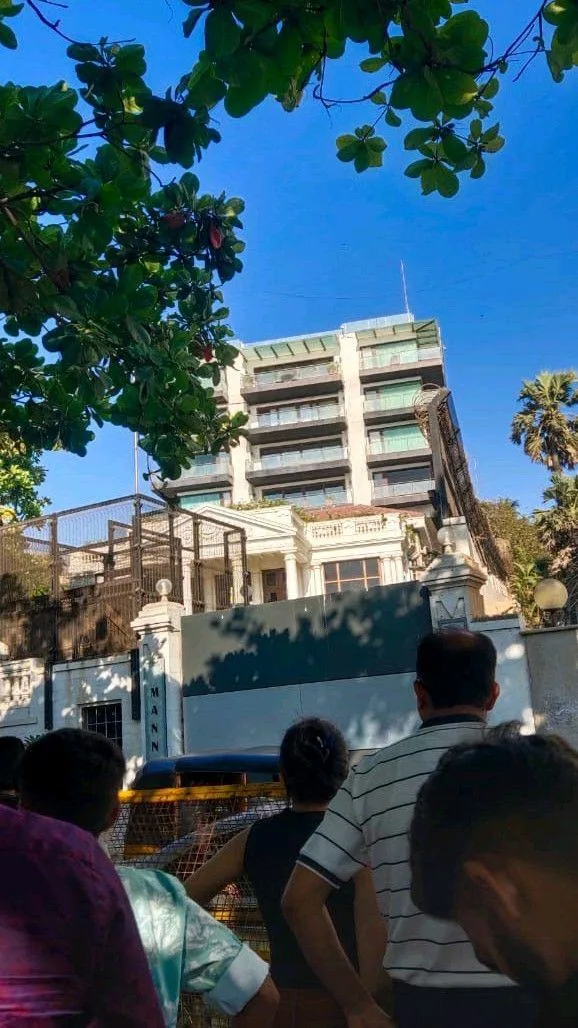
Mannat, Bandstand, Mumbai: the gate at the centre of this book. (Image: Final Thesis archive)
Behind closed doors, everyone “If not for Shah Rukh Khan” Then for whom will the largest democracy of the world stand behind? The Country known to have found independence from the british in 1947 on the sheer grit and tenacity of non cooperation, not seeing a single fan outside his Mannat standing in silence to speak of the atrocities…
It is printed here exactly as it was first written, unpolished, because it is the reason this book exists. (Recollection)
The date
The date that matters is not the one the cameras remember.
The cameras remember 30 October 2021, when Aryan Khan came home to Mannat after more than three weeks in custody, and the road outside his father’s house filled with fans, drums, police barricades and broadcast vans. That night is well documented. (Fact)
This book begins earlier. On the night of 2 October 2021, Gandhi Jayanti, the Narcotics Control Bureau detained Aryan Khan after a raid on a cruise ship bound for Goa, and arrested him on 3 October. On 4 October he was produced before a magistrate and remanded to the Bureau’s custody. (Fact) In May 2022 the Bureau’s own charge sheet left his name out for want of sufficient evidence. (Fact)
4 October is the day the author remembers. In her account, the road outside Mannat that day held no vigil: no crowd standing in silence, no candle, no placard, none of the people who had spent thirty years turning one man’s face into a national habit. (Recollection) Later reports describe fans gathering and police clearing crowds outside the house; they do not settle what the street looked like hour by hour on that one day, and this book does not pretend they do. (Fact; the gap is recorded in Part X)
The question
This is not a book about a court case. The courts and the investigators have their record, and it is cited where it belongs, in Part IV, kept apart from anyone’s feelings about it.
It is a book about a question nobody asked out loud.
India is the country that taught the twentieth century what standing still can do. Its freedom was not won by an army. It was won by millions of ordinary people who refused, marched, sat down in the road and waited until the most powerful empire on earth had to listen. Silence, in this country, was once a weapon. (Fact; Analysis)
So what does it mean to be loved by a billion people, and to stand alone at your own gate?
What is a fan, if the fandom ends where the trouble begins? Millions bought the films, the tickets, the posters, the cola, the cars, the paint and the phone plans with his face on them. Millions learned the open-armed pose by heart. How many of them understood that the face they kept was a person, with a family, on a bad day? (Analysis)
The man who built the line
The question is sharper because of who he is. Long before any Indian studio had a social media team, Shah Rukh Khan was trying to talk to his audience directly, without a newspaper or a channel in between. In 2000 he put his own life online, room by room, on a website he co-founded. In 2011 he turned a superhero film into a digital universe. In 2013 he ran a train on tweets. He spent a decade building a direct line between a star and the people who loved him. (Fact; told in Part II)
On 4 October 2021, in this account, the line was silent from the other end. (Recollection; Analysis)
What happened next is the strangest comeback in the history of Indian cinema. He disappeared from the screen for four years and from interviews almost entirely. Then, in 2023, he released three films in a single year, and two of them each crossed ₹1,000 crore worldwide. He barely spoke to the press while doing it. The fans came back. Not to his gate: to the cinemas. (Fact; told in Part V)
Why this book, and why now
In December 2026 a film called KING opens. This book is written in the months before it, by someone who stood beside him when the line was first built, and who believes the next chapter of the line will not be written by a studio at all.
To understand why, we have to go back to the beginning: to a boy from Delhi, to a television serial about a soldier, to a man who mapped his own life into rooms and invited the world in. We follow the line from there, through the empire that almost was, the years of the apparent lull, the silence, the resurrection and the kingdom, to the card he has not yet played. (Analysis)
The silence is where the question started. It is not where the story starts.
From the Final Thesis
Added from the Final Thesis, word for word. Where a figure here differs from the sourced figure earlier in this chapter, the chapter’s figure stands; see Addendum B.
PROLOGUE — THE KINGDOM THAT FORGOT HOW TO PLAY
There was a time when Shah Rukh Khan was not merely selling films.
He was building worlds.
In 2011, a superhero named G.ONE stepped out of a Bollywood film and into an experiment that connected cinema, technology, gaming, merchandising, digital communities and the possibilities of intellectual property.
In 2013, a train began moving across the internet, powered by fans. Every tweet was a little push. Every milestone became a shared achievement. Cinema was no longer just something that happened on a screen. It became something an audience could participate in.
And then, gradually, something changed.
Between 2014 and 2018, the public-facing digital campaigns continued to produce innovations, but the ambition of building an integrated, enduring entertainment ecosystem appeared to recede. Interactive campaigns gave way more often to platform promotions, character-led content, film-specific activations and the familiar machinery of release marketing.
Why?
Was it economics? Was the technology ahead of its time? Had the industry learned to monetise the attention without investing in the ecosystem? Had the digital revolution become too expensive, too complicated or too inconvenient for the machinery around it?
Or was something more fundamental happening to the relationship between the creator, the star, the audience and the system that profited from all three?
Then came ZERO.
And after ZERO, the silence.
It was not the celebration when Aryan returned home.
It was the moment before that, when the world outside appeared, in Gupta’s recollection, to have gone quiet.
The personal ordeal was not the beginning of the technological story. It was the straw that broke the camel’s back in the narrative developed here: the moment when years of questions about fandom, institutions, creative control and the meaning of public support acquired an intensely personal dimension.
Then, from the apparent stillness, came Pathaan.
Then Jawan.
Then Dunki.
And now KING.
The central question of this thesis is not whether Shah Rukh Khan has returned to stardom. The box office has already supplied an answer.
The question is whether the next chapter of his career will return to the unfinished digital revolution of Ra.One and Chennai Express—or whether the King is preparing to build something that the old rules of Bollywood cannot contain.
(Final Thesis, section 29)
Executive Summary
The Shah Rukh Khan phenomenon is often discussed through the familiar vocabulary of stardom, box-office collections, brand endorsements, and celebrity fandom. Each of these explains a part of the picture. None, on its own, explains the full scale of the opportunity.
The more revealing question is how these assets interact.
In 2011, Ra.One demonstrated that a Hindi film could be developed and marketed as a multi-platform entertainment property, integrating technology, merchandising, gaming, brand partnerships, social media, and fan interaction. In 2013, Chennai Express took the digital proposition further, using analytics, mobile products, social participation, fan clubs, and real-time campaign intelligence.
These were not merely campaigns that happened to use the internet. They were early experiments in treating digital participation as part of the entertainment itself.
The subsequent decade saw a major change in the media environment: social platforms became dominant distribution channels, fan attention became increasingly fragmented, and film marketing became more dependent on platform algorithms, short promotional cycles, and individual release events. Shah Rukh Khan’s public career moved through an equally extraordinary series of developments, culminating in the 2023 releases of Pathaan, Jawan, and Dunki.
The three films reportedly generated more than ₹2,600 crore in worldwide box-office collections combined, according to contemporary industry reporting.
But the financial and cultural comeback raises a separate strategic question: has the digital marketing ambition of the Ra.One and Chennai Express era been fully revived, or has the industry largely retained the promotional machinery while leaving the larger fan-powered ecosystem unrealised?
This study examines that question through four interconnected lenses:
- Digital marketing history: From early integrated campaigns to platform-led film promotion.
- Brand and cultural economics: How the value of a superstar can extend beyond individual films.
- The human dimension: How the events of October 2021 became a turning point in the author’s interpretation of the relationship between celebrity, public support, and institutional power.
- The future: Whether KING, global business expansion, interactive AI technologies, and fan participation could converge into a new model of entertainment.
The paper does not claim that all the developments discussed are part of a single, confirmed strategy. Nor does it claim access to Shah Rukh Khan’s private intentions. Its purpose is to identify the documented milestones, distinguish the author’s firsthand perspective from public evidence, and present a strategic hypothesis for further investigation.
The hypothesis is straightforward:
The next evolution of celebrity marketing may not be another bigger campaign. It may be a persistent, participatory entertainment ecosystem in which fans become creators, distributors, collaborators, and stakeholders in the cultural life of an intellectual property.
(Final Thesis, section 42)