Part I · The Origin of the King, 1965 to 1999 · 6 of 57
Chapter 4 · TV Cereal: six and a half hours, 1988 to 1991
[image: SRKWorld.com, 2000: TV Cereal]
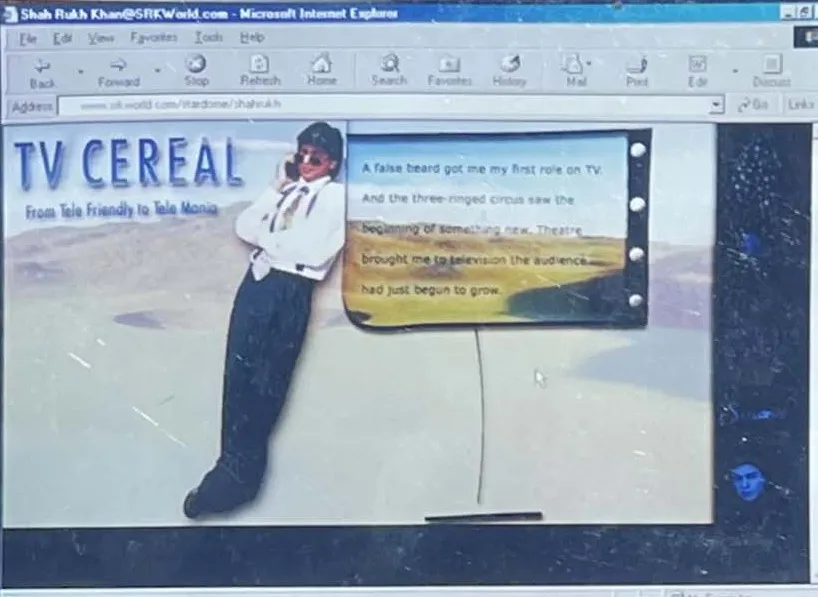
SRKWorld.com, 2000: “TV Cereal”. (Archive: the author’s collection)
He was meant to debut in a serial called Dil Dariya. It was delayed, so the country met him first as somebody else’s idea of a soldier. (Fact)
The part was meant for the director’s own son. Lt. Col. Raj Kumar Kapoor wanted a new face instead, and his son-in-law, a property dealer who had met the young Khan while showing houses, put his name forward. The audition was a run of a mile and a half at dawn, followed by boxing. (Fact. The Hollywood Reporter India, 28 Nov 2024) The sportsman who had lost his sport to a shoulder won his first role by running and boxing. (Analysis)
Fauji premiered on DD National on 18 January 1989: thirteen episodes about army recruits training to become commandos. He was cast as a second lead. Kapoor said the camera “loved him so much” that the script was rewritten around Lieutenant Abhimanyu Rai. (Fact. Wikipedia: Fauji; Scroll, 7 Dec 2015) Three years later he summed it up for India Today: “In six-and-a-half hours I became the nation’s heartthrob.” (Fact. quoted in The Hollywood Reporter India)
The arithmetic explains the miracle. In 1989 India had one national channel. Every episode of Fauji reached the whole television audience at once, because there was nothing else to watch. Thirteen half-hour episodes, six and a half hours of air time, put one face into every home with a set. (Analysis) [Unverified] the number of television households in India in 1989, from Doordarshan or the census. For scale, by 1995 television reached more than 70 million Indian homes. (Fact. Wikipedia: Television in India)
Iskra. The success brought him to Iskra, a Bombay production house run by Kundan Shah, Aziz Mirza and Saeed Mirza, which cast him in Umeed, Wagle Ki Duniya and Circus, nineteen episodes on DD National in 1989 and 1990. (Fact. Wikipedia: Circus) All three men return in this book. Kundan Shah would direct him in Kabhi Haan Kabhi Naa. Aziz Mirza would direct Raju Ban Gaya Gentleman and, in 1999, found Dreamz Unlimited with him and Juhi Chawla. Saeed Mirza sent him to Mani Kaul, who cast him in Idiot, a Dostoevsky adaptation that opened at the New York Film Festival in October 1992. (Fact. Wikipedia: Idiot; Wikipedia: Red Chillies Entertainment) The circus tent of 1989 is where the business partnership of 1999 began. (Analysis)
In the same years he took a small part in In Which Annie Gives It Those Ones (1989), Arundhati Roy’s first screenplay, directed by Pradip Krishen. It aired once on Doordarshan and all but disappeared, until a 4K restoration was selected for the Berlinale Classics in 2026. (Fact. The Statesman, 22 Jan 2026) The art cinema of Mani Kaul and Arundhati Roy, and the mass television of Fauji: he did both at once. (Analysis)
1991. His mother died, of complications of diabetes. (Fact) [Unverified] a 2026 report gives 1990; a primary record would settle the year. In April 1991 he decided to act in films, partly as a way of coping with the loss, and moved to Mumbai, taking on the care of his sister, Shahnaz, who had fallen into depression after their parents’ deaths and lives with his family still. (Fact) On 25 October 1991 he married Gauri, in three ceremonies on one day: civil, Hindu and the nikah. (Fact. Wikipedia: Gauri Khan; Business Today, 11 July 2026) Their children would be raised in both faiths. (Fact)
Television was his first direct line into the homes of the country: one channel, one evening a week, a whole nation looking at the same face, with no middleman. He would spend the next thirty-five years looking for its successor. (Analysis)
He arrived in Mumbai with no film family, no godfather and no money, a television face in an industry of dynasties. Everything he built after that, he built in public. (Analysis)
Lekh Tandon. The serial he was meant to debut in, Dil Dariya, was the work of Lekh Tandon, the director of the 1966 film Amrapali, who is credited with discovering him. Wikipedia dates the serial’s run to 1988-1989. (Fact. Wikipedia: Lekh Tandon) (Method note: this book’s account has Fauji reaching viewers first, in January 1989; both dates are printed.) Tandon then directed him in Doosra Keval, thirteen episodes on DD National from 1989 to 1990, as Keval, a village boy killed by a close friend after he refuses to do illegal work for him. (Fact. Wikipedia: Doosra Keval) Tandon died on 15 October 2017, aged 88. (Fact. Wikipedia: Lekh Tandon)
The reruns. During the COVID-19 lockdown of 2020, Doordarshan rebroadcast Circus and Fauji alongside Ramayana and Mahabharata, and on 14 May 2020 it announced that Doosra Keval would return as well. (Fact. Business Today, 14 May 2020) Thirty-one years on, the same public channel reached for the same young face to hold a country that could not leave home. The one-channel nation of 1989 had briefly come back, and so had its heartthrob. (Analysis)
Fauji 2. On 18 November 2024 a sequel, Fauji 2, premiered on DD National and the Waves streaming service, produced by Sandeep Singh, Vicky Jain and Zafar Mehdi under Legend Studios, with Vicky Jain and Gauahar Khan in the leads. He is not in its cast. (Fact. Wikipedia: Fauji 2) Its trailer was released as a tribute on his birthday, 2 November 2024, and its title track was sung by Sonu Nigam. (Fact. DT Next, 2 Nov 2024) A state broadcaster relaunching a 35-year-old title on his birthday shows that Fauji had become his brand as much as the army’s. (Analysis)
Shekharan. In Circus he played Shekharan Rai, in a story set inside a touring troupe, the Apollo Circus; the episodes are credited to Aziz Mirza or Kundan Shah, and the series to the writer V. K. Sharma. (Fact. Wikipedia: Circus) The Quint describes Shekharan as a Malayali circus owner, while Wikipedia names the owner as Babuji. (Method note: the sources disagree; both are printed.) Before the lockdown reruns, Doordarshan had already brought Circus back once, on DD National from 19 February 2017, announcing it on Twitter; his co-star Renuka Shahane thanked the channel. (Fact. The Quint, 17 Feb 2017)
Ahamaq. Mani Kaul’s Idiot reached the public first as television: Ahamaq, a four-part mini-series on Doordarshan in 1991, which never had a commercial cinema release. In October 2016 the 18th Mumbai Film Festival showed the unedited series as a four-hour film, with a live score by the Vitaly Tkachuk Quartet from Ukraine. (Fact. The Quint, 13 Oct 2016) Even his art-house screen debut came to the country through the state broadcaster before it reached any cinema. (Analysis)
The size of the audience. The media historian Amit Khanna counts about 2.1 million television sets in India at the end of 1982 and fifteen million TV homes by the end of the decade; the same passage also speaks of more than 15 million sets, so homes and sets are not cleanly separated. (Fact. Amit Khanna, Words, Sounds, Images (HarperCollins India), excerpt in BloombergQuint) The same book records that in 1986 the metros got a second channel. (Fact. same source) (Method note: the “one national channel” of 1989 holds for the national network; viewers in the largest cities already had a second choice. Item 7 in Addendum G stays open until a Doordarshan or census figure for 1989 is found.)
The money behind the screen. Doordarshan was not only a public service; by the year of Fauji it was a business. Answering in the Lok Sabha, the Ministry of Information and Broadcasting gave its gross revenue from commercial advertisements and programme sponsorship year by year, and said advertisements took between 2.5% and 3% of total transmission time. (Fact. Lok Sabha, written answer to Question 1101, 25 July 1989)
| Year (April to March) | Doordarshan gross revenue, advertisements and programme sponsorship | Source |
|---|---|---|
| 1986-87 | ₹96.0 crore | Lok Sabha, 25 July 1989 |
| 1987-88 | ₹136.3 crore | Lok Sabha, 25 July 1989 |
| 1988-89 | ₹161.3 crore | Lok Sabha, 25 July 1989 |
| 1989-90 | ₹210.13 crore | Lok Sabha, 18 May 1990 |
The first quarter of 1989-90, the months after Fauji’s premiere, brought in ₹50.55 crore, against ₹39.75 crore in the same quarter a year earlier. (Fact. Lok Sabha, 25 July 1989) In May 1990 the ministry also ranked the advertising agencies by the business they brought the channel; Lintas India came first, then Hindustan Thomson Associates and Ogilvy Benson and Mather. (Fact. Lok Sabha, 18 May 1990)
The channel’s ad and sponsorship income more than doubled in four years, from ₹96 crore to ₹210 crore, across exactly the seasons in which he went from unknown to heartthrob. (Analysis) The face that held the one-channel nation was also the face that sold its airtime: a star made on a screen whose revenue came from the brands around him. That is the first appearance of the pattern this book follows to Pepsi, Hyundai and the Knight Riders. (Analysis) [Unverified] which company, if any, sponsored Fauji on Doordarshan; a Doordarshan sponsorship record or the opening card of an original broadcast tape would settle it (Addendum G).
Umeed. Of the Iskra work, Umeed (1989) returned to view in April 2023, when clips of a television film about a banker spread on social media. He plays Anand Gupta, a new bank employee posted to a remote village who has to learn how to settle in. (Fact. DNA India, 29 Apr 2023; The Quint, 28 Apr 2023) Viewers compared it with the streaming series Panchayat, whose city graduate also takes a job in a village office. (Fact. same sources) The Doordarshan archive of 1989 had become content for a new platform’s audience, thirty-four years later. (Analysis)