Part I · The Origin of the King, 1965 to 1999 · 7 of 57
Chapter 5 · The Wall: the villain who became the lover, 1992 to 1999
[image: SRKWorld.com, 2000: The Wall]
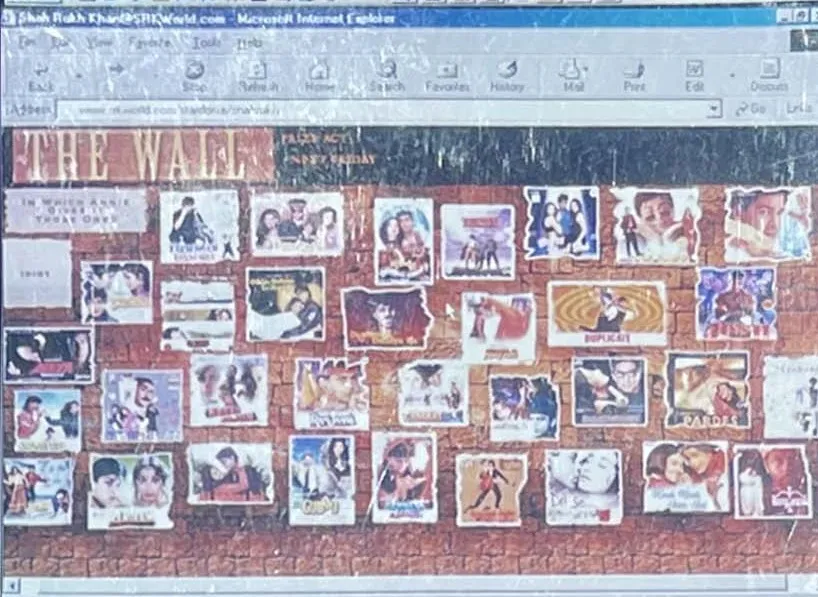
SRKWorld.com, 2000: “The Wall”, his films as posters on a brick wall. (Archive: the author’s collection)
A country opening up. He arrived in Bombay in the year India changed course. In July 1991 the government began to dismantle the licence raj. On 2 October 1992 Zee TV went on air as the first private Hindi satellite channel, and Doordarshan’s monopoly on the evening was over. (Fact. Wikipedia: Zee TV) A new middle class was about to discover brands, satellite television and itself. It needed a hero who looked like it: urban, quick, self-made and a little dangerous. (Analysis)
1992: four films in one year. The first film he signed was Hema Malini’s Dil Aashna Hai, but the first to reach cinemas was Deewana, in June 1992, in which he was the second male lead to Rishi Kapoor. It was a hit and won him the Filmfare Award for Best Male Debut. Chamatkar, Dil Aashna Hai and Raju Ban Gaya Gentleman followed the same year; the last, directed by Aziz Mirza from the Circus days, began his long screen partnership with Juhi Chawla. (Fact) A critic later described the early Khan “sliding down stairs on a slab of ice, cartwheeling, somersaulting”. (Fact. Arnab Ray, DNA, quoted in Wikipedia) He was not the most polished actor in the room. He was the one you could not stop watching. (Analysis)
1993: the anti-hero. Then he did what no aspiring romantic hero did. He played villains. In Abbas–Mustan’s Baazigar he was a murderer and an ambiguous avenger; it was a hit, his first film with Kajol, and his first Filmfare Award for Best Actor. In Yash Chopra’s Darr he was an obsessive lover stalking Juhi Chawla, and the stammered “I love you, K-k-k-Kiran” passed into everyday speech. (Fact) The convention was simple: the hero is good, the villain is someone else. He collapsed the two. Audiences who should have recoiled from the stalker and the killer cheered for them, because he played them as wounded men rather than monsters. (Analysis)
1994: the actor’s actor. Anjaam, opposite Madhuri Dixit, brought the Filmfare Award for Best Performance in a Negative Role. Kabhi Haan Kabhi Naa, Kundan Shah’s small film about a lovable loser, brought the Critics Award; he has called it his favourite role. (Fact) Once again, the men who had backed him on television gave him his best early work. (Analysis)
1995: the year that never ended. He had seven releases in 1995. Karan Arjun was the year’s second-highest grosser. The highest was Dilwale Dulhania Le Jayenge, Aditya Chopra’s debut, released on 20 October 1995. (Fact. Wikipedia: DDLJ) It won ten Filmfare Awards, then a record. It was the first Hindi blockbuster with non-resident Indians as its heroes; it ran for more than a year in the United Kingdom and turned the diaspora into a market studios could bank on. (Fact. same source) Raj, the boy from London who would not elope but waited for the father’s blessing, gave a generation living between two countries a hero who belonged to both. (Analysis)
At Mumbai’s Maratha Mandir it has screened every day since 20 October 1995. It passed Sholay as the longest-running film in Indian cinema in 2001 and reached 1,000 weeks in December 2014. When the cinema announced in February 2015 that the run would end, fans protested and the run was reinstated. It had reached 1,251 weeks by March 2020, paused for the lockdown and resumed in November 2020. (Fact. same source) In October 2025, at its thirtieth anniversary, it was still playing there every day at 11:30 am, past 1,500 weeks, for ₹40 a seat. (Fact. AFP, via Channels TV, 19 Oct 2025) No marketing department kept that film alive. Its audience did. It was a fan campaign before the phrase existed. (Analysis)
1996: the fall. All four of his releases in 1996 failed. (Fact) The industry that had crowned him a year earlier began to ask whether the moment had passed. (Analysis)
1997: the comeback, and a son. Yes Boss, Pardes, one of the first major Hindi successes in the United States, and Yash Chopra’s Dil To Pagal Hai, which won him his third Filmfare Best Actor award. (Fact) On 13 November 1997 his first child, Aryan, was born. (Fact. Wikipedia: Aryan Khan) Three years later, his father named his first technology company after him. (Recollection; Part II)
1998: the films travel. Mani Ratnam’s Dil Se.., released on 21 August 1998, was only an average grosser at home, about ₹28.4 crore on an ₹11.5 crore budget. Abroad it became the first Indian film to enter the UK top ten and won the NETPAC Award at Berlin. (Fact. Wikipedia: Dil Se..) Two months later Karan Johar’s debut, Kuch Kuch Hota Hai, became the year’s biggest Hindi film: about ₹80 crore in India and about $6.3 million abroad, the first Bollywood film past US$5 million overseas and the second, after Dil Se.., in Britain’s top ten. (Fact. Box Office India via Wikipedia: Kuch Kuch Hota Hai) The first two Hindi films ever in the UK top ten were both his. (Fact, as above) The same year he toured the UK, Canada and the US on stage with Juhi Chawla, Akshay Kumar and Kajol in The Awesome Foursome. (Fact) The diaspora was not an afterthought to his career. It was half of it. (Analysis)
The three films that built the wall
| Measure | Baazigar (1993) | Dilwale Dulhania Le Jayenge (1995) | Kuch Kuch Hota Hai (1998) |
|---|---|---|---|
| Released | 12 November 1993 | 20 October 1995 | 16 October 1998 |
| Director | Abbas–Mustan | Aditya Chopra | Karan Johar |
| Reported budget | ₹3 crore | ₹4 crore | ₹10 crore |
| Reported gross | ₹32 crore, India | ₹102.5 crore, worldwide | about ₹106.7 crore, worldwide |
| Gross ÷ budget | about 10× | about 25× | about 10× |
| Filmfare awards | 4, including his first Best Actor | 10, then a record | 8 |
| What it proved | A villain could be the hero | The diaspora was a market | Overseas could be counted in millions of dollars |
(Fact. Wikipedia pages of the three films, October 2026. Gross is not profit; the ratio is this book’s arithmetic. Sources disagree on DDLJ’s total, and another estimate puts it near ₹200 crore by 1996. The last row is Analysis.)
The first brand. In 1998 Hyundai, a carmaker almost unknown in India, launched the Santro with him as its face. He hesitated to lend his name to a brand few had heard of. The partnership lasted about twenty-six years, one of the longest in Indian advertising, and Hyundai became the country’s second-largest carmaker. (Fact. Storyboard18) The man who would later carry thirty brands on one film began by carrying one nobody knew. (Analysis)
1999: the partnership. In 1999 he founded Dreamz Unlimited with Juhi Chawla and Aziz Mirza, the director from the circus tent of 1989. (Fact. Wikipedia: Red Chillies Entertainment) The actor was about to become a producer, and the producer was about to go online.
Open arms on a mustard field. A stammer that became a catchphrase. A train roof in the Nilgiris. The myth that KING now plays against was written in these eight years. Everything that follows is what one man did with it. (Analysis)
The hits between the three. The table above follows three films. Three other hits of the decade show the same pattern at a smaller scale: modest budgets, large multiples, and an overseas audience that grew every year. (Method note)
| Measure | Karan Arjun (1995) | Pardes (1997) | Dil To Pagal Hai (1997) |
|---|---|---|---|
| Director | Rakesh Roshan | Subhash Ghai | Yash Chopra |
| Released | 13 January 1995 | 8 August 1997 | 1997 (exact date not in the sources read) |
| Reported budget | N/A (not stated in the source read) | ₹10 crore | about ₹9 crore |
| Reported gross, India | ₹36.75 crore | ₹34.83 crore (body text); the collections table gives ₹43.83 crore including ₹12 crore entertainment tax | N/A (not given separately) |
| Reported gross, overseas | N/A (not given separately) | $1.7 million (about ₹6.12 crore at 1997 rates) | N/A (not given separately) |
| Reported gross, worldwide | ₹45 crore | ₹40.95 crore (infobox); ₹49.95 crore (collections table) | over ₹71 crore (Wikipedia); ₹72 crore (DNA) |
| Place in its year | Behind DDLJ in 1995 (see above) | 4th in India in 1997; 2nd overseas | Highest-grossing Indian film of 1997 |
(Fact. Wikipedia: Karan Arjun; Wikipedia: Pardes; Wikipedia: Dil To Pagal Hai, via Wikiwand; DNA, 15 June 2024, all read November 2026. The two Pardes and two Dil To Pagal Hai totals are printed as the sources give them; gross is not profit.)
1997 abroad: first and second. Overseas, the two biggest Hindi films of 1997 were both his. Dil To Pagal Hai led the year; Pardes, a story about an Indian family in America, came second, and India Today later called it one of the first major Bollywood pictures to succeed in the United States. (Fact. Wikipedia: Pardes, citing India Today) So the overseas record that Kuch Kuch Hota Hai set in 1998 was not a surprise. After DDLJ in 1995 and his two films of 1997, it was the third time in four years that his work had led the diaspora market. (Analysis)
Small budgets, big multiples. Dil To Pagal Hai was made for about ₹9 crore and grossed over ₹71 crore worldwide: roughly eight times its cost. It won eight Filmfare Awards from eleven nominations and three National Film Awards. (Fact. Wikipedia: Dil To Pagal Hai, via Wikiwand; the multiple is this book’s arithmetic) Across the decade the budgets of his biggest hits stayed between about ₹3 crore and ₹10 crore. That was the economics of the wall: a producer who cast him risked little and could earn many times over. Directors kept coming back for that reason, as well as for the talent. (Analysis)