Part III · The Years of the Apparent Lull, 2014 to 2018 · 17 of 57
Chapter 15 · The Box-Office Graph
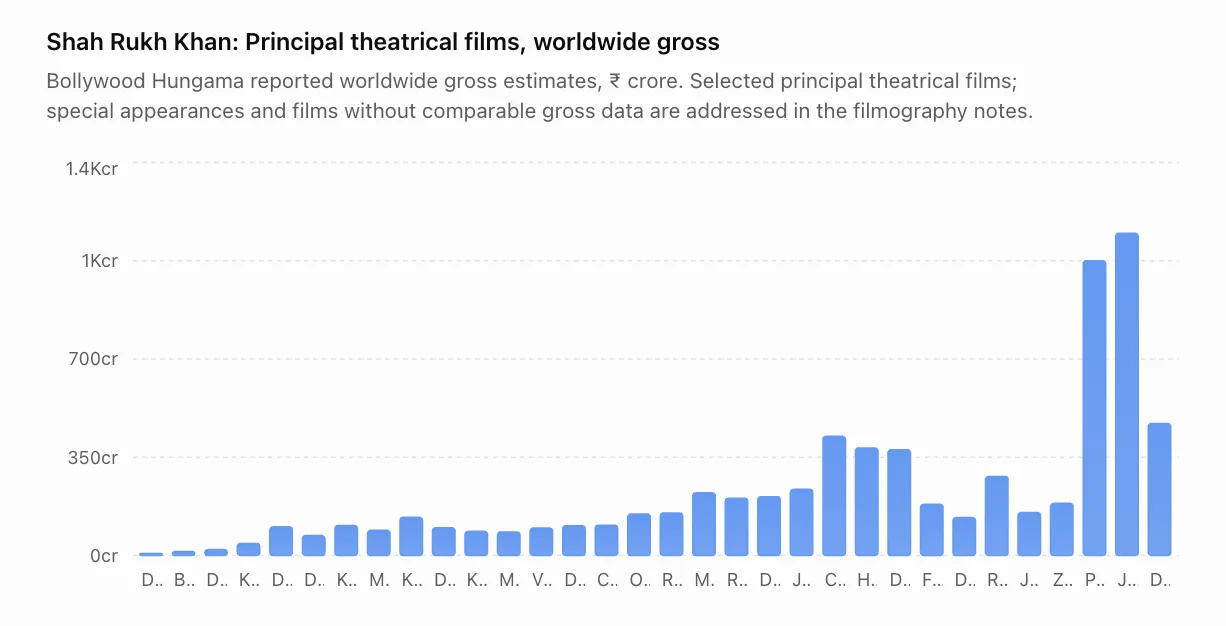
The career-long view, as drawn in the Final Thesis: principal theatrical films, worldwide gross, Bollywood Hungama estimates. (Chart: Final Thesis)
The curve tells the story the matrix implies. From 2010 to 2013 each film was bigger than the last, up to Chennai Express. From 2014 to 2018 the seven films never reached that level again, and the line falls to its lowest point with Zero. Then there is a gap of four years with no lead release at all, and in 2023 the line goes through the roof: two films past ₹1,000 crore and a third past ₹400 crore. (Analysis)
Two cautions keep the graph honest. Gross is ticket sales, not profit; a film can gross less and still earn more for its producer through satellite, streaming and music rights, which are not published film by film. And the money and the innovation are different measures, drawn on different charts in this book for a reason: a high gross does not prove a good campaign, and a weak gross does not prove a bad one. Zero had the most inventive campaign of the five years and the weakest result. (Method note; Analysis)
From the Final Thesis
Added from the Final Thesis, word for word. Where a figure here differs from the sourced figure earlier in this chapter, the chapter’s figure stands; see Addendum B.
The film-by-film record
| Year | Film | Worldwide gross estimate (₹ crore) |
|---|---|---|
| 2014 | Happy New Year | 383.10 |
| 2015 | Dilwale | 376.85 |
| 2016 | Fan | 182.33 |
| 2016 | Dear Zindagi | 135.47 |
| 2017 | Raees | 281.44 |
| 2017 | Jab Harry Met Sejal | 153.43 |
| 2018 | Zero | 185.99 |
Source: Bollywood Hungama worldwide collection listing. These are trade estimates, not audited receipts.
The numbers establish that this was a period of continued theatrical activity, not an absence of releases.
They also establish that the films had significantly different commercial outcomes.
What they do not establish is why the marketing approach may have changed.
(Final Thesis, section 60)
The complete theatrical trajectory: the graph
The box-office record is essential, but it must be read correctly.
A film’s worldwide gross is not a marketing metric. It reflects multiple variables: the film itself, distribution, ticket prices, release scale, audience demand, competition, exchange rates, and the market in which it was released.
It cannot independently prove that a digital campaign caused a particular commercial outcome.
The following graph uses Bollywood Hungama’s published worldwide gross estimates for the principal theatrical films in the source dataset. The figures are nominal reported grosses, in ₹ crore; they are not adjusted for inflation, ticket prices, or market size.
Source: Bollywood Hungama’s Shah Rukh Khan worldwide box-office listing. Older historical figures are trade estimates and can differ materially across databases, especially for early releases. The graph is a principal-film comparison, not a claim to include every cameo, voice role or guest appearance.
Between 2014 and 2018, the worldwide gross estimates for the selected films range from approximately ₹135 crore for Dear Zindagi to ₹383 crore for Happy New Year. The period contains commercial successes, underperforming films, and films with different budgets, genres and distribution footprints.
The 2023 figures represent a different commercial scale in this dataset: Pathaan at ₹1,050.30 crore, Jawan at ₹1,148.32 crore, and Dunki at ₹470.60 crore.
The graph is not the verdict. It is the beginning of the investigation.
(Final Thesis, section 59)
The larger filmography: beyond the box-office chart
The graph above deliberately separates a comparable theatrical dataset from the broader filmography.
A complete study of Shah Rukh Khan’s screen career must distinguish lead roles from supporting performances, guest appearances, cameos, voice performances and appearances as himself.
The Bollywood Hungama filmography includes, among other credits, Bhoothnath Returns (2014), Tubelight (2017), Ae Dil Hai Mushkil (2016), Brahmāstra: Part One – Shiva (2022), Laal Singh Chaddha (2022), Rocketry: The Nambi Effect (2022), Tiger 3 (2023), Mufasa: The Lion King (2024, English-language voice role), and The Zoya Factor (2019).
These credits matter to the marketing narrative because they represent different relationships between the star, the film and the audience.
A cameo may create attention disproportionate to screen time. A voice role may depend on a different promotional strategy. A guest appearance may be designed to support another film’s universe rather than establish a Shah Rukh Khan-led property.
(Final Thesis, section 60)
The ruler moved: ticket prices and seats
A third caution sits under every rupee on the graph: the price of a cinema ticket in India kept rising. Ormax Media puts the average ticket price at ₹92 in 2015, ₹106 in 2019 and ₹130 in 2023, while admissions in 2023 were 94.3 crore, still below the 103.0 crore of 2019. (Fact. Ormax Media, The Ormax Box Office Report 2023, Jan 2024)
| Year | Average ticket price, India (₹) | Admissions, India (crore) |
|---|---|---|
| 2015 | 92 | 90.3 |
| 2016 | 96 | 90.1 |
| 2017 | 95 | 101.0 |
| 2018 | 104 | 94.5 |
| 2019 | 106 | 103.0 |
| 2020 | 91 | 22.5 |
| 2021 | 87 | 42.7 |
| 2022 | 119 | 89.2 |
| 2023 | 130 | 94.3 |
Source: Ormax Media, The Ormax Box Office Report 2023. All languages, all of India; the report does not cover 2010-2014. (Fact)
On that ruler, 2023 was the most valuable year Indian cinema had recorded: ₹12,226 crore gross, the first year past ₹12,000 crore, with Hindi films at 44% (₹5,380 crore, up from 33% in 2022). Jawan led the year at ₹734 crore India gross, Animal was second at ₹645 crore, Pathaan third at ₹636 crore; Ormax lists Dunki at ₹252 crore. (Fact. afaqs!, 23 Jan 2024; Ormax Media, Jan 2024) These are India grosses for all language versions; the worldwide figures on the graph above are a different measure, and both are printed. (Method note) Jawan sold about 3.5 crore tickets in India. (Fact. The Core, 26 Jan 2024) Ormax’s report gives no ticket count film by film, so the admissions of Pathaan and Dunki are N/A here. (Method note)
Read together, the numbers temper the 2023 spike without erasing it. An average ticket cost about 41% more in 2023 than in 2015 (₹130 against ₹92), so part of the gap between Happy New Year and Pathaan on the graph is price, not people. Yet Jawan alone drew roughly one in every 27 cinema admissions in India that year (3.5 crore of 94.3 crore), in a year when total attendance had not yet returned to 2019. The resurrection was real in seats as well as in rupees. (Analysis)
The ruler after 2023. Ormax’s next two annual reports carry the same measure up to the year before KING. (Method note)
| Year | India gross, all languages (₹ crore) | Admissions, India (crore) | Average ticket price (₹) | Hindi gross (₹ crore) | Top film of the year, India gross |
|---|---|---|---|---|---|
| 2024 | 11,833 | 88.3 | 134 | 4,679 | Pushpa 2: The Rule, ₹1,403 crore (all versions) |
| 2025 | 13,395 | 83.2 | 161 | 5,504 | Dhurandhar, ₹950 crore |
Sources: Ormax Media, The Ormax Box Office Report 2024, 11 Jan 2025; Ormax Media, The Ormax Box Office Report 2025, 15 Jan 2026. (Fact)
2024 fell 3% below 2023 in rupees and 6% in admissions, and Ormax found that about 31% of the year’s Hindi gross came from South Indian films dubbed into Hindi. (Fact. Ormax Media, 11 Jan 2025) 2025 then set a new record of ₹13,395 crore and Hindi’s best year at ₹5,504 crore, with Dhurandhar named the highest-grossing Hindi film of all time; yet admissions fell another 6% while the average ticket rose 20%. (Fact. Ormax Media, 15 Jan 2026)
On this ruler, 2025’s record was bought with price, not people: 83.2 crore admissions is fewer than any year in the table above except the pandemic years 2020 and 2021, and a ticket cost about 75% more than in 2015 (₹161 against ₹92). Jawan’s 3.5 crore tickets would have been about one in every 24 admissions of 2025. (Analysis) Hindi cinema beat its 2023 rupee record without a single Shah Rukh Khan lead release in 2024 or 2025; the money his three films proved was there is now shared with others. (Analysis)
For KING on 24 December 2026, the graph will need both measures. A ticket in 2025 cost about 24% more than in 2023 (₹161 against ₹130), so a KING gross equal to Jawan’s ₹734 crore in India would mean fewer seats filled, not the same number. This book will print KING’s rupees and, where a source gives them, its admissions; where none does, admissions stay N/A. (Method note; Analysis)