Part III · The Years of the Apparent Lull, 2014 to 2018 · 20 of 57
Chapter 18 · Five Conclusions
- Ra.One set the franchise ambition. Its significance was the attempt to make a film character live beyond the film, through games, merchandise, technology and a relationship with the audience.
- Chennai Express set the benchmark for an integrated campaign. Its innovation was the combination: participation, original digital products, coordinated fan clubs, analytics, brands and creative decisions changed every day.
- Later campaigns kept individual innovations but not the architecture. Happy New Year, Dear Zindagi, Jab Harry Met Sejal and Zero all experimented. Their innovations were tied to one film, one campaign or one platform.
- Zero is the most important qualification. Bauua Ki Toli, the character’s own accounts, the Alexa skill and the Snapchat lens show real digital ambition in 2018. Any claim of a complete withdrawal from innovation has to answer for them.
- The gap is in sustained, technology-led franchise building. The evidence shows a less consistent continuation of the integrated model. It does not, on its own, explain why, or who decided.
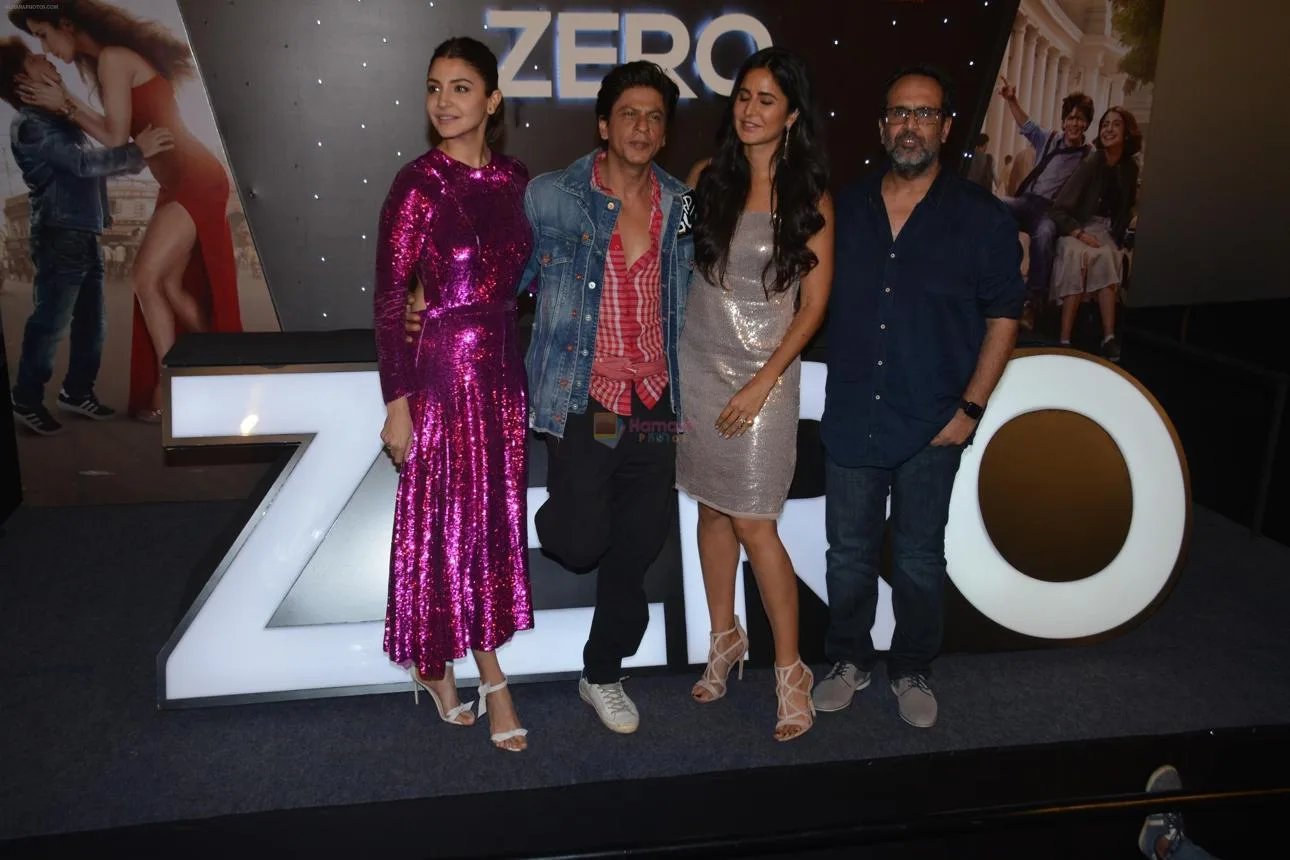
The Zero trailer launch, November 2018. (Image: Final Thesis archive)
(Analysis, on the evidence of Chapters 10 to 17)
In one sentence: between Ra.One and Chennai Express, his film marketing joined technology, fan participation, original entertainment products, merchandise and data into one system; from 2014 to Zero in 2018, single campaigns kept inventing, but the system was not rebuilt; his personal involvement is documented in the first period, and the reasons for the change in the second are not yet on the record. (Analysis)
Zero opened on 21 December 2018. Four months later, in Beijing, where it closed the Beijing International Film Festival, he told CGTN: “Maybe I made the wrong film.” If something does not excite you in the morning, he said, you should not wake up. (Fact. Gulf News / IANS, 19 Apr 2019) Then he did something no one expected. He stopped. His next lead release would be more than four years away. (Fact)
In the language of this book, Zero is the 0 in Zero to One: the lowest point, and the start of the climb. And then, nothing.
The industry caught up
The first conclusion can be tested from outside his films. Ra.One’s reported online spend, about ₹15 crore of a ₹52 crore marketing budget (Chapter 10), comes to about 29 per cent. (Analysis, arithmetic from Chapter 10) Six years later the norm was half that. A December 2017 report by ESP Properties, the entertainment and sports arm of GroupM, put digital at 10 to 15 per cent of a film’s marketing budget in India, against 45 to 50 per cent for television, 10 to 15 per cent for print and 25 to 30 per cent for activations. (Fact. Social Samosa, 15 Dec 2017)
The second edition of that report, covering 2018, counted ₹606 crore spent on marketing Indian films that year, across 1,087 releases (951 in 2017). Television took 47 per cent (₹285 crore) and digital 28 per cent (₹170 crore). (Fact. exchange4media, 28 May 2019; the headline rounds the total to ₹600 crore)
| Year | Whose spend | Digital share of marketing spend | Source |
|---|---|---|---|
| 2011 | Ra.One, one film | About 29% (₹15 cr of ₹52 cr) | Chapter 10 |
| 2017 | Films in India, typical budget | 10–15% | Social Samosa, 15 Dec 2017 |
| 2018 | All Indian films, 1,087 releases | 28% (₹170 cr of ₹606 cr) | exchange4media, 28 May 2019 |
Read together, the rows say the rest of the industry reached in 2018, by share of spend, roughly where Ra.One stood in 2011. That sharpens the fifth conclusion: what thinned after 2013 was not money moving online, which every studio did, but the franchise layer built on top of it. The comparison is rough. One row is a single film’s reported budget, the others are averages from a media agency’s report, and “online” and “digital” may not be counted the same way. (Analysis; Method note)
The fourth conclusion gains one more item. Days before Zero opened, Red Chillies unveiled Bauua Ki Dukaan, a line of the film’s merchandise: mugs, headphones, mobile covers, badges, T-shirts and personalised autograph posters. (Fact. Licensing Corner, 16 Dec 2018) Where the line was sold and how much of it sold are not in the public record: N/A. (Method note)
What the agency reports say about the franchise layer
The December 2017 ESP Properties report also priced the brand side of film marketing. It put co-branded marketing media spend for Hindi films at about ₹100 crore a year, and a film’s marketing budget at 10 to 15 per cent of its production budget. (Fact. exchange4media, 14 Dec 2017) From 2015 to 2017 it counted at least one FMCG co-branded film campaign a month, with around 13 brands active. (Fact. same)
The 2018 edition, Showbiz 2.0, measured what the money bought at the top. The 40 films with the biggest opening weekends spent on average ₹4.46 crore each on television for 321,000 seconds of airtime, nearly twice the rest; their YouTube trailers drew almost 50 million views, over 4.8 times the average for the other films. (Fact. exchange4media, 28 May 2019) Of the year’s ₹606 crore, print took 7 per cent and outdoor 6 per cent. (Fact. PrintWeek, on the 2018 Showbiz report, page undated)
The same 2018 report looked back. It named Krrish, Ra.One and A Flying Jatt as superhero films that had “conquered successful merchandise sales”, and expected domestic superheroes to see a new dawn of franchising. (Fact. exchange4media, 28 May 2019) Seven years after its release, the industry’s own media agency still cited Ra.One as a merchandise precedent, in the year Zero sold mugs and badges. That supports the first and fifth conclusions together: the franchise layer was recognised as an asset outside his company, while his own films after 2013 did not rebuild it. (Analysis)
Neither report publishes figures for single films, so whether Zero was among 2018’s top 40 openers, and what its own campaign spent, is N/A here. (Method note)
Where the money moved: rights sold before release
The fifth conclusion has a commercial side. On 15 December 2016 Netflix announced a long-term deal with Red Chillies Entertainment: his old films and the new ones due in Indian cinemas over the next three years would stream exclusively to its 86 million-plus members worldwide, starting with Dear Zindagi. No financial terms were published: N/A. (Fact. Business Standard / IANS, 15 Dec 2016)
By October 2018 Koimoi reported that Zero’s satellite rights had gone to the Zee network in a multi-film deal for Red Chillies productions, and its digital rights to Netflix under the deal with him. Neither amount was disclosed: N/A. (Fact. Koimoi, 8 Oct 2018) Koimoi’s phrase for the Netflix side, hundreds of crores, is [Unverified]: a company filing or a statement from either party would settle it. (Method note)
The cinema rights were sold differently from his earlier films. Bollywood Hungama reported Zero’s all-India distribution rights at about ₹100 crore in total, on an advance basis rather than a minimum guarantee, so distributors could claim money back from the producers if they lost; collections above ₹100 crore were to be shared, 85 per cent to Red Chillies, and it put the break-even at ₹190 to 195 crore nett in India. (Fact. Free Press Journal / Bollywood Hungama, 2018, page updated 29 May 2019) Sacnilk’s final count was ₹96.61 crore nett and ₹120.80 crore gross in India, ₹57.20 crore overseas and ₹178.00 crore worldwide, against the ₹20.14 crore nett of its first day. (Fact. Sacnilk, updated 27 Jan 2019) Chapter 14’s worldwide figure, about ₹191 crore from Wikipedia, is higher; both are printed because the sources disagree. (Method note)
Read together, by 2018 a film of his was largely paid for in rights before its first show, and the advance basis meant a short run sent part of the loss back to the producer. None of those contracts had a line for the franchise layer that Ra.One had tried to build: the rights were sold film by film, which is the pattern the fifth conclusion describes. (Analysis)
The other side of the rights deals: refunds when a film fell short
The advance basis on Zero had a history behind it. After Dilwale (2015), Bollywood Hungama reported that Red Chillies, which had taken over the film’s India distribution, refunded its distributors about half of their losses. It put the domestic minimum guarantee at ₹130 crore and the distributors’ share of collections at about ₹70 to 75 crore, a loss of about ₹55 to 60 crore, and the refund at close to ₹25 crore. (Fact. Bollywood Hungama, 9 Feb 2016) Four days earlier Deccan Chronicle had called the refund trade buzz: the analyst Komal Nahata tweeted the 50 per cent figure, while the trade analyst Vikas Mohan said, “There is no truth in this.” (Fact. Deccan Chronicle, 5 Feb 2016) The ₹25 crore is [Unverified]: a statement from Red Chillies or the distributors would settle it. (Method note)
The same reports traced the habit back. Bollywood Hungama said he had refunded the distributors of Asoka (Eros, 2001) and Paheli (UTV, 2005). (Fact. Bollywood Hungama, 9 Feb 2016) Deccan Chronicle, citing Boxoffice India, described the form it took: after Asoka, Chalte Chalte was sold to the same distributors at a lower price; after Paheli, Om Shanti Om was offered first to those who had lost money. (Fact. Deccan Chronicle, 13 Feb 2016)
After Jab Harry Met Sejal (2017), the reported shares differ, so both are printed. Deccan Chronicle, citing Bollywood Hungama, reported 15 per cent of the losses returned to NH Studioz, which had bought the India rights for ₹80 crore, and said he was not legally bound to pay. (Fact. Deccan Chronicle, 12 Dec 2017) The Quint, the same day, gave 15 per cent to NH Studioz and 30 per cent to the other distributors, and headlined 30 per cent. (Fact. The Quint, 12 Dec 2017) A year later LatestLY, citing Bollywood Hungama, put the film’s rights at ₹85 crore on a minimum guarantee, not ₹80 crore. (Fact. LatestLY, 27 Oct 2018)
| Film | India theatrical rights, as reported | Basis | Refund to distributors, as reported | Sources |
|---|---|---|---|---|
| Dilwale (2015) | ₹130 cr | Minimum guarantee | About 50% of losses, close to ₹25 cr; denied by one analyst | Bollywood Hungama; Deccan Chronicle |
| Jab Harry Met Sejal (2017) | ₹80 cr (NH Studioz) or ₹85 cr | Minimum guarantee | 15% to NH Studioz; 30% to others (The Quint only) | Deccan Chronicle; The Quint; LatestLY |
| Zero (2018) | About ₹100 cr (above) | Advance, refundable by contract | N/A: no report of a payment found | LatestLY |
Read in order, the rows show a refund that began as goodwill, a rights price for the next film or a share of the loss, and by Zero was written into the sale itself. The rights price fell from ₹130 crore for Dilwale to ₹80 to 85 crore for Jab Harry Met Sejal, and Zero’s about ₹100 crore came with no guarantee at all. For the fifth conclusion this is the other half of the rights pattern: the producer carried more of each film’s risk, film by film, with no franchise income to spread it over. (Analysis)