Part IV · The Ghost in the Present, 2019 to 2022 · 21 of 57
Chapter 19 · The Silence
Four years without a lead release. Almost no interviews. A star who had built an empire on talking let the silence talk for him. Then, in October 2021, the silence changed sides. This Part keeps two records apart on purpose: what the public record shows, and what the author remembers.
2019: the year without a film. He worked, but off screen. Red Chillies made Bard of Blood for Netflix, and in October 2019 he sat with David Letterman for Netflix’s My Next Guest Needs No Introduction. (Fact. American Bazaar, 10 Oct 2019) On his 54th birthday, 2 November 2019, the crowd at his gate waited for an announcement that did not come. He told them: “The day it will be announced will be our birthday.” (Fact. India TV) The only stage he kept was the balcony. (Analysis)
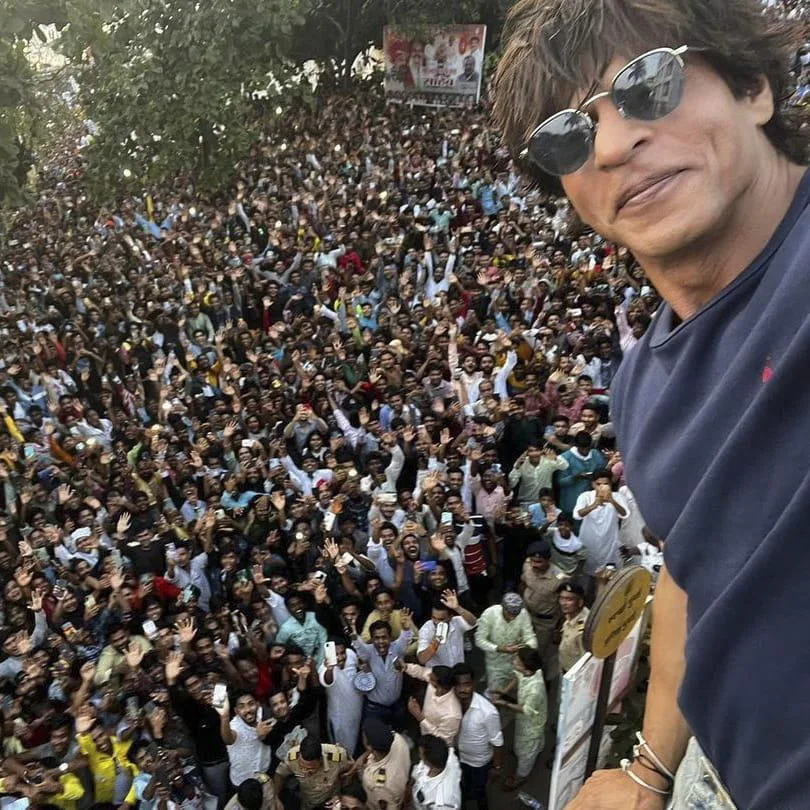
Fans outside Mannat: the crowd that kept the line open through the silence. (Image: Final Thesis archive)
2020: the work without a campaign. When the pandemic reached Mumbai, he and Gauri Khan offered their four-storey personal office to the city as a quarantine facility for women, children and the elderly; his Meer Foundation committed daily food for more than 5,500 families, and his companies gave to the PM-CARES Fund and the Maharashtra relief fund. (Fact. The Tribune, 4 Apr 2020) He did it without a campaign. (Analysis) In the Caribbean his Trinbago Knight Riders won the 2020 Caribbean Premier League unbeaten, twelve wins from twelve. (Fact. Wikipedia: Trinbago Knight Riders)
The company kept working. Between Zero and Pathaan, Red Chillies released Badla (2019), Bard of Blood (2019), Kaamyaab (2020), Betaal and Class of ’83 (2020), Bob Biswas (2021), and Love Hostel and Darlings (2022): eight titles in four years, none starring him. (Fact. Wikipedia: Red Chillies Entertainment) The silence was the actor’s, not the company’s. (Analysis)
[image: SRKWorld.com, 2000: the fans’ page]
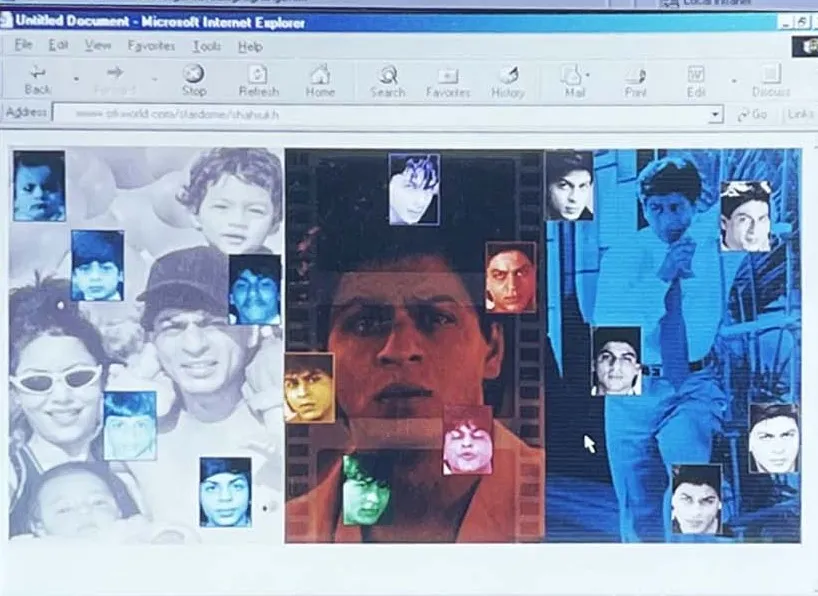
SRKWorld.com, 2000: the fans’ page. (Archive: the author’s collection)
The fans held the line. Silence is not absence. The fan clubs did not wait for permission. They kept the birthday at the gate, trended the old films and built their own campaigns. The brand was being held by the people who loved it. (Analysis) Was the silence a wound, or a weapon? What did he see from the balcony, every birthday, that the industry did not? (The author’s questions)
From the Final Thesis
Added from the Final Thesis, word for word. Where a figure here differs from the sourced figure earlier in this chapter, the chapter’s figure stands; see Addendum B.
2019–2020 — When the machinery goes quiet
The years following ZERO brought a pause in Shah Rukh Khan’s theatrical film releases.
For a performer whose public identity had been built around an unusually close relationship with audiences, the pause created a vacuum.
A superstar can be absent from the screen and remain culturally present. His films continue to circulate, his image remains commercially valuable, and his audience continues to interpret his silence.
But a pause in theatrical releases does not establish a pause in private ambition.
Nor does it prove that an undisclosed business plan, technology project or cinematic strategy exists.
The public record can establish what was released, announced, invested in or documented. It cannot reveal every private decision behind a period of reduced public activity.
For the purposes of this thesis, the interval is important because it separates the highly visible film campaigns of 2010–2018 from the extraordinary public events that followed.
Then came October 2021.
(Final Thesis, section 22)
When the King became ZERO
In 2018, ZERO brought Shah Rukh Khan into a distinctive cinematic and promotional world built around Bauua Singh.
The campaign used character-led content, WhatsApp stickers, Bauua Ki Toli rewards, Alexa and Snapchat AR. The promotional strategy continued to experiment with the ways a film character could travel across digital platforms.
This is why ZERO matters to the thesis.
It was not a complete withdrawal from digital marketing.
It was a film that continued to explore digital engagement, but did not publicly establish a permanent, interconnected fan ecosystem on the scale of the ambitions associated with Ra.One and Chennai Express.
And after ZERO, the theatrical pause began.
The title has since acquired an almost irresistible symbolic quality.
ZERO is a number, a film title and, in the narrative developed here, a point of departure.
A star who had helped build digital worlds appeared to enter a period of reduced cinematic visibility.
Was it a retreat? A recalibration? A private reassessment? A consequence of the economics and organisational realities of the industry?
The public record cannot tell us.
But it can establish the contrast between the earlier campaign ambitions and the long gap before the next major theatrical phase.
That contrast is the reason ZERO belongs at the centre of this thesis.
Not as proof of failure.
As the end of a chapter whose unfinished business remained unresolved.
(Final Thesis, section 33)
ZERO: A symbolic endpoint
ZERO, released in 2018, provides a compelling symbolic endpoint for this phase of the story.
The title itself creates a narrative bridge back to the beginning of the digital experiments and forward to the later return.
ZERO is not used here as a judgement on the film’s creative merit or commercial performance. It is a narrative marker: the close of one period of the Shah Rukh Khan story, followed by an extended interval before his return to leading theatrical roles.
The question is not whether the superstar disappeared.
The question is what happens to an ecosystem when its central figure steps away from the familiar release cycle, and whether the digital relationship with the audience can survive independently of the next film.
That question would become far more personal in October 2021.
(Final Thesis, section 44)
The question that matters to the marketing study
What happens when a brand built partly on visibility, connection and constant public communication suddenly becomes silent?
Conventional crisis communications often emphasise immediate statements, reputation management, controlled messaging and the management of public perception.
But a personal family crisis is not simply a brand crisis.
The choice not to turn a family’s legal ordeal into a marketing narrative may be a boundary between private life and public work. Whether it was a conscious communications strategy cannot be established without reliable evidence.
The silence nevertheless created a striking contrast with the highly visible campaigns of the previous decade.
In the context of this study, October 2021 is the human rupture between the earlier innovation narrative and the subsequent cinematic resurgence.
It is not a claim that personal tragedy caused later commercial success.
It is a moment after which the public-facing story of the star changed.
(Final Thesis, section 61)
The volcano metaphor
The author’s interpretation is that the period represented a profound isolation: a moment when a figure associated with mass adoration seemed to be standing alone in an atmosphere of public fear and scrutiny.
That interpretation can be retained as a personal and cultural lens, provided the publication distinguishes it from a factual claim about the entire public.
The case study’s central question is more precise:
How did a superstar’s public-facing brand evolve when personal silence was followed by a return to large-scale cinematic communication?
The answer requires the next act.
(Final Thesis, section 61)
How the silence broke, 2020 to 2022
Back on a set, November 2020. On 18 November 2020 he began shooting Pathan, as the title was then spelt: a Yash Raj Films production directed by Siddharth Anand, with Deepika Padukone and John Abraham. It was his first film shoot since Zero two years earlier, after a pause in which he had told Filmfare, “I have no film with me right now.” (Fact. The Week, 18 Nov 2020) The screen stayed dark, but the work had restarted eleven months before October 2021; from outside, nobody could see it. (Analysis)
A bandaged face, June 2022. On 3 June 2022 he announced Jawan, his first film with the Tamil director Atlee, with a teaser in which a bandage covered most of his face. It was produced by Red Chillies, with Gauri Khan as producer, and dated for 2 June 2023 in five languages: Hindi, Tamil, Telugu, Malayalam and Kannada. (Fact. Business Today, 3 Jun 2022) (That date later moved; see Chapter 24.)
Thirty years, June 2022. On 25 June 2022, to mark thirty years in the film industry since Deewana (1992), he shared his first look from Pathaan as a motion poster, dated for cinemas on 25 January 2023 in Hindi, Tamil and Telugu; John Abraham posted the same look on his own Instagram. (Fact. The Week, 25 Jun 2022)
The silence became a calendar. With Dunki’s title video of 19 April (Chapter 25), three films had release dates within ten weeks, each one seven to twenty months ahead. He still gave the press almost nothing; he gave the fans dates. The first two pictures of him in 2022 hid his face: one under bandages, one in a guarded look. A man coming back from the hardest year of his life chose to be seen only in part. (Analysis)