Part IV · The Ghost in the Present, 2019 to 2022 · 24 of 57
Chapter 22 · Asoka to Boo-Da
In 2001 he played Asoka, the emperor who conquered everything, saw the cost at Kalinga, and laid down his sword for the Buddha’s path. This book bends that story. Between Asoka and the Buddha sits the “boo”: the jeers after Zero, the trolling, the October the whole country watched. Boo-Da is the man on the other side of the boos, a man the noise no longer reaches. (Analysis)
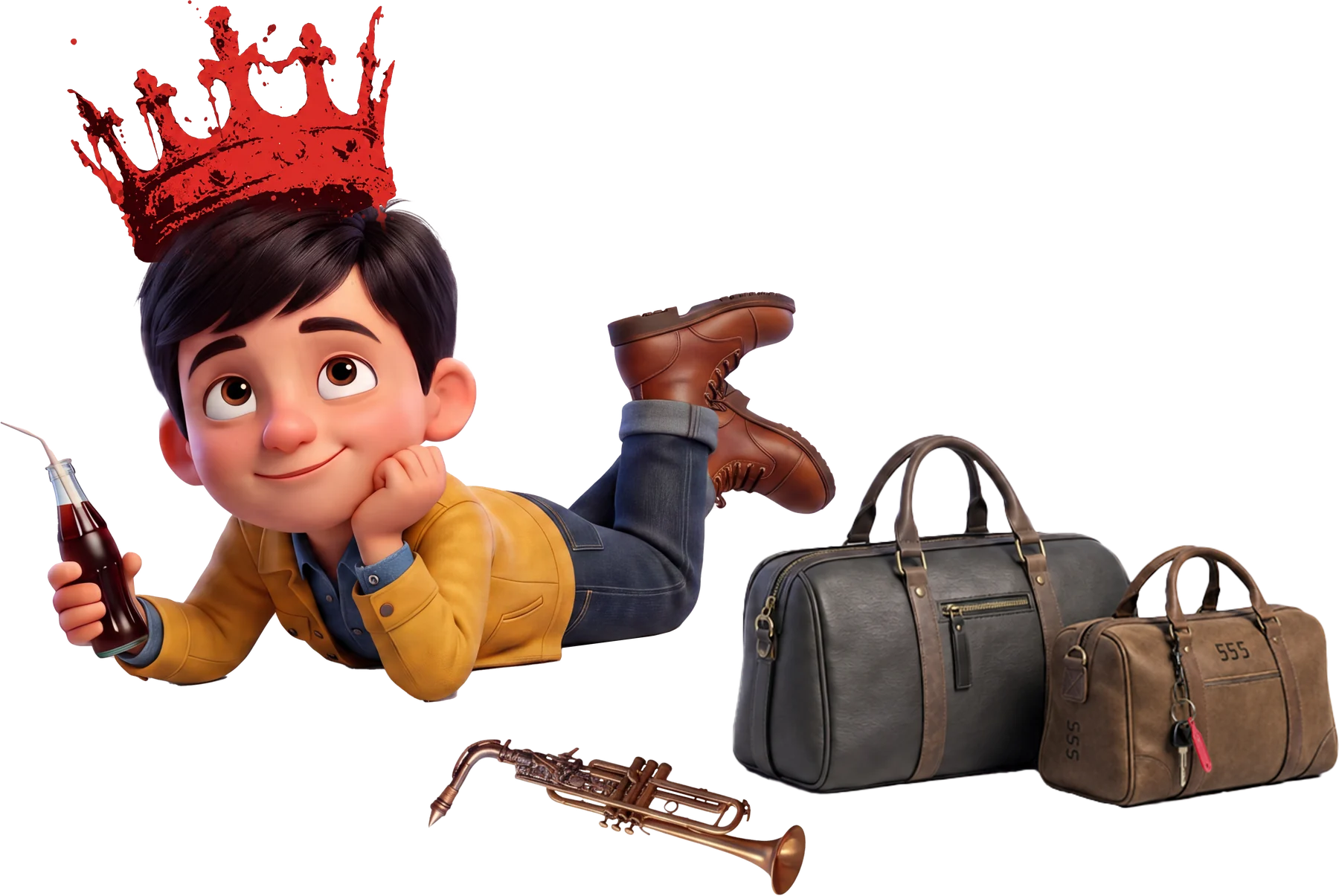
Asoka to Boo-Da. (The campaign's art, agarmainkinghota.com)
Asoka renounced the sword. The man in this story did something stranger. He renounced the microphone, and kept the sword. For four years he gave almost no interviews, sat out every argument, made no statement on his son’s case, and let the films that were not yet made speak for him. Silence, the weapon his father’s generation had used against an empire, became his. (Analysis)
What does a father do with that kind of humiliation? And what does a showman do when he decides not to perform? (The author’s questions)
He waits. In 2022 he returned to the screen only in small parts in other people’s films, guest appearances in Rocketry and Brahmastra, while his own film was being finished. (Fact. Gulf News) On 2 November 2022, his 57th birthday, a teaser appeared. (Fact. Sacnilk)
When he came back, he did not ask to be seen.
From the Final Thesis
Added from the Final Thesis, word for word. Where a figure here differs from the sourced figure earlier in this chapter, the chapter’s figure stands; see Addendum B.
The emperor, the empire and the absurdity of power
Here is where the thesis takes its most unusual turn.
Ashoka is remembered in Indian history through the transformation associated with the Kalinga war and his subsequent embrace and patronage of Buddhism.
The popular narrative is one of a ruler confronting the human cost of conquest and turning towards a different conception of power.
Now transpose that arc into the absurd theatre of modern celebrity.
Not Ashoka to Buddha.
ASOKA TO BOODA.
Be Da Boo-Da.
A satirical, darkly comic phrase for a modern King who has played the game, built the empire, supplied the spectacle, and then appears to have stepped back from the very machinery that made him powerful.
The joke is deliberately irreverent.
The metaphor is not a claim that Shah Rukh Khan has undergone a religious transformation, nor that he privately identifies with Ashoka or Buddha. It is a fictional interpretive device for examining the public arc of a celebrity and the systems around him.
(Final Thesis, section 35)
The first act: ASOKA
The emperor builds.
He conquers markets, expands territory, creates alliances and turns his name into an institution.
In the Shah Rukh Khan version of this satire, the empire is not built with armies.
It is built with cinema, characters, digital campaigns, fan clubs, brand partnerships, technology and the extraordinary machinery of mass attention.
Ra.One is the experiment in technological conquest.
Chennai Express is the campaign that turns the audience into an army of participants.
The King discovers that the internet can become a kingdom, the fan can become a citizen, and a film can become an ecosystem.
But every empire has a bureaucracy.
Every revolution develops intermediaries.
And every successful system creates people whose livelihoods depend on keeping that system operating in familiar ways.
The satire begins when the emperor discovers that the machinery of the empire may not share his appetite for revolution.
(Final Thesis, section 35)
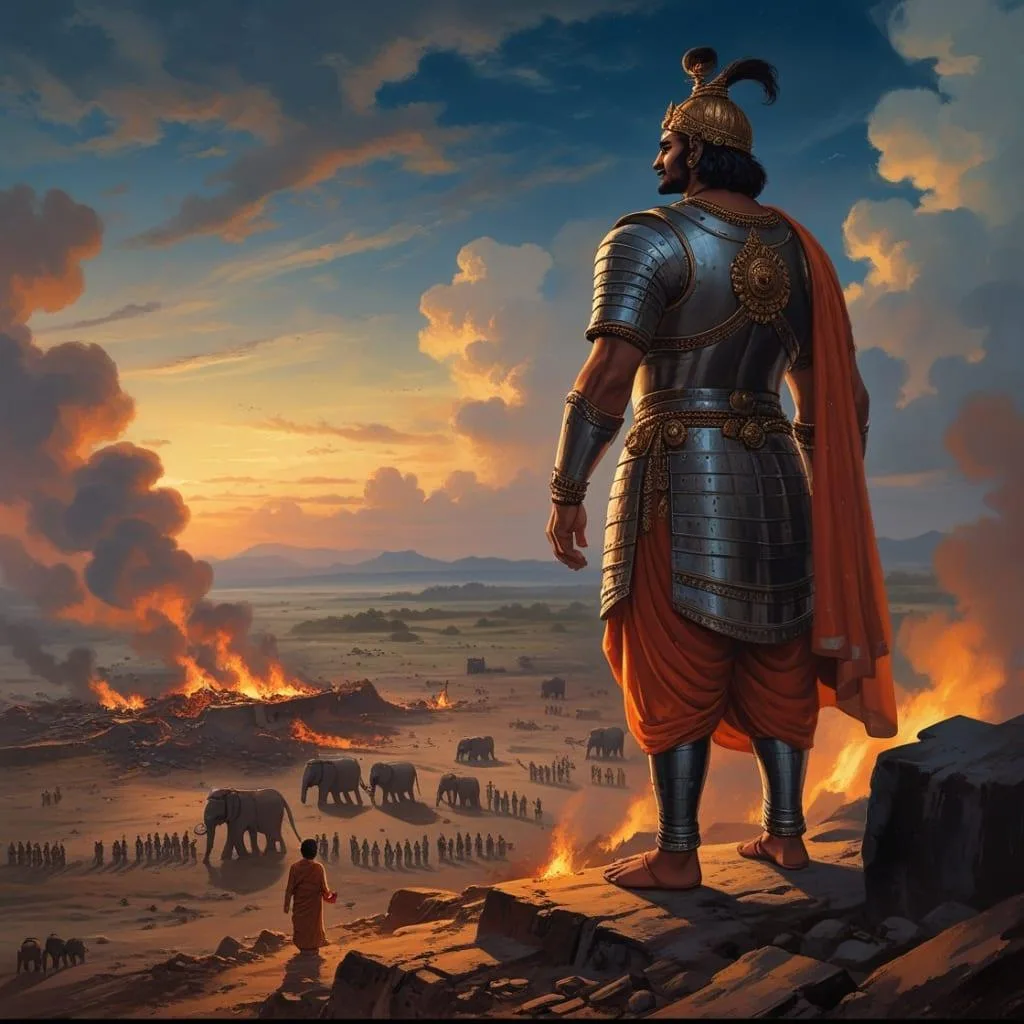
Asoka at Kalinga: the conqueror who laid down his sword. (Illustration: Final Thesis archive)
The second act: BOO-DA
The King stops playing the old game.
Or appears to.
The digital universe is not sustained at the level its early experiments suggested. The campaign machinery continues, but the permanent ecosystem remains elusive.
The King becomes ZERO.
The empire continues to exist. The audience remains enormous. The films and the brand continue to command attention.
But the grand technological experiment appears to have gone quiet.
In the satire, the emperor has not necessarily lost his kingdom.
He has become tired of the circus.
The word BOO-DA is the punchline: a deliberately playful inversion of the image of the conqueror becoming a contemplative figure.
The King has seen the machinery.
He has seen the cost of conquest.
And now, instead of endlessly expanding the old empire, perhaps he is asking a different question.
What is the point of having millions of followers if the system only knows how to turn their attention into a sale?
What is the point of building an entertainment universe if the audience has no continuing role in it?
What is the point of being KING if the rules of the kingdom never change?
The 2021 crisis becomes, in this satirical construction, the straw that breaks the camel’s back.
Not the established cause of a private transformation, but the dramatic rupture around which the narrative turns.
The emperor has experienced the machinery of public life from another side.
The fan is no longer merely an enthusiastic participant in a campaign.
The superstar is no longer merely the centre of a commercial ecosystem.
The old equation—star creates, fans consume, platforms distribute, brands monetise—starts to look insufficient.
(Final Thesis, section 35)
The third act: Be Da Boo-Da
This is the central creative proposition.
What if the apparent retreat was not the end of the story?
What if the King returned with a different understanding of the game?
The satire asks whether the next phase could be less about conquering attention and more about creating an ecosystem in which audiences participate in the making of entertainment.
Less about the King commanding the crowd.
More about the King creating a world in which the crowd can become a creator.
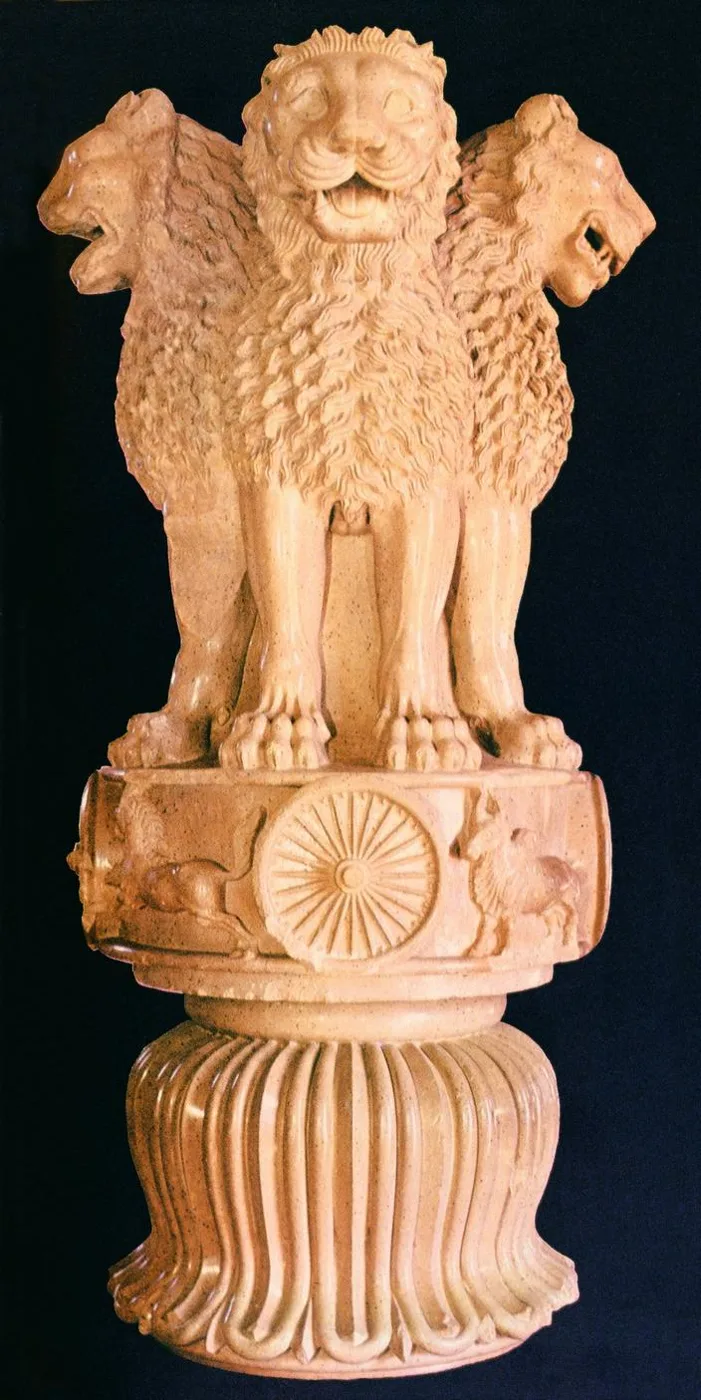
The Lion Capital of Asoka. (Image: Final Thesis archive)
Less about the old empire’s promotional machinery.
More about a new architecture of storytelling, technology and fan participation.
This is the point at which ASOKA TO BOODA becomes more than a catchy phrase.
It becomes a lens through which the entire career arc can be examined.
The emperor builds an empire.
The empire becomes a machine.
The machine reaches its limits.
The King withdraws.
The King returns.
And now the question is whether he will rebuild the same empire—or change the rules of the kingdom.
Be Da Boo-Da.
The joke is on the machinery of power.
The suspense is about what the King does next.
(Final Thesis, section 35)
ASOKA TO BOO-DA: The ghost of the sage’s present
The title is a metaphor, not a historical equivalence.
Ashoka’s association with conquest, remorse and renunciation provides the philosophical counterpoint. The author’s interpretation of BOO-DA is a contemporary, satirical reversal: not a ruler abandoning power, but a figure confronting the rules of the game and choosing to play on.
The ghost of the sage’s present is the past that refuses to disappear.
In this case, it is the memory of an experiment that may have arrived before the technology, economics and audience behaviours necessary to sustain it.
Ra.One was the experiment.
Chennai Express was evidence of the power of digital measurement.
The intervening years raise the question of whether the experiment’s underlying ambition survived.
The 2023 films demonstrate the continued capacity of Shah Rukh Khan’s screen presence to generate extraordinary commercial and cultural attention.
FLAM provides a documented connection to a business exploring interactive AI media.
SRKWORLD offers a proposed framework for what fan participation might become.
And KING provides the present-tense mystery.
(Final Thesis, section 67)
The Kalinga ledger. The emperor’s turn has a number attached, and the number is his own. In his Thirteenth Rock Edict, dated in one sourcebook to 256 BCE, Ashoka records that 150,000 people were deported from Kalinga, 100,000 were killed, and many times that number died. (Fact. Ashoka, Thirteenth Rock Edict, in McKay et al., Sources) The World History Encyclopedia dates the war itself to about 260 BCE. (Fact. Joshua J. Mark, World History Encyclopedia, 24 Jun 2020) No independent count of Kalinga’s dead survives; the only ledger is the one the conqueror chose to carve. (Method note)
Three guest rooms, 2022. The waiting year can be read film by film. In each, he walked into another director’s story for a few minutes and walked out again.
| Released | Film | His part | What the record adds | Source |
|---|---|---|---|---|
| 9 September 2022 | Brahmastra Part One: Shiva (Ayan Mukerji) | Mohan Bhargav, a scientist of the secret Brahmansh, keeper of the Vanarastra | The name repeats his NASA employee in Swades (2004); Mukerji called the scene’s tone “a little bit Iron Man-like” | Free Press Journal, 9 Sep 2022; DNA, 25 Sep 2022 |
| 11 August 2022 | Laal Singh Chaddha (Aamir Khan’s remake of Forrest Gump) | A brief appearance, likened to Elvis Presley’s in the original | Aamir Khan had confirmed the cameo before release | DNA, 11 Aug 2022 |
| 1 July 2022 | Rocketry: The Nambi Effect (R. Madhavan) | A guest role, acted in both the English and Hindi versions | Madhavan said he charged no fee; the director first narrated the story to him on the set of Zero | Free Press Journal, 27 Jun 2022 |
(Fact, as reported by the sources in the table.)
The pattern fits the chapter’s bend of the story. Asoka’s edicts measure the cost of conquest; the 2022 record measures restraint: three courts visited, none claimed, one visit unpaid. The Rocketry link runs back to Zero, the film whose failure opens the “boo”; the Brahmastra name runs back to Swades, the film about a man who comes home. (Analysis)