Part V · The Resurrection, 2023 · 25 of 57
Chapter 23 · Pathaan: the return
He came back on his own terms: no media tour, no explaining, only the films, the fans and the balcony. The silence had turned into scarcity, and scarcity into an event.
The comeback began, as the fans had been promised, on his birthday. On 2 November 2022 the Pathaan teaser arrived. (Fact. Sacnilk) What followed broke every rule of the playbook he had written. (Analysis)
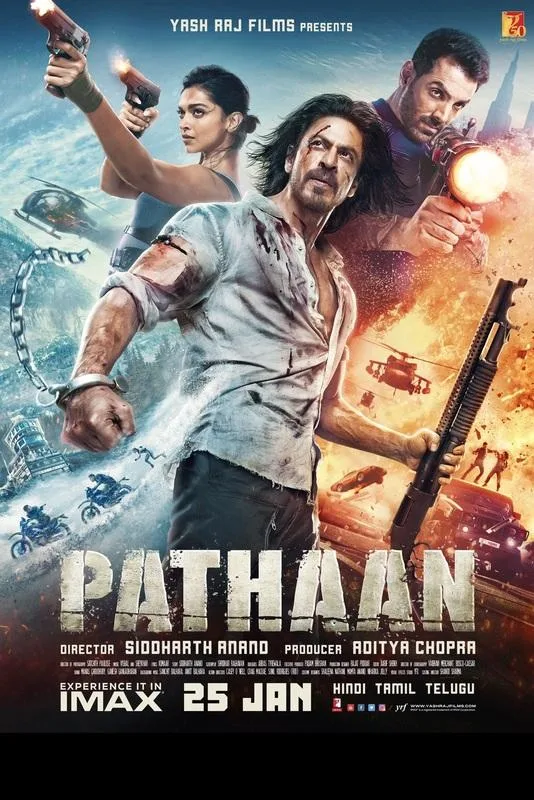
Pathaan (2023)
One more boycott. In December 2022 the first song, “Besharam Rang”, drew protests over a saffron-coloured bikini; a Madhya Pradesh minister called it objectionable, effigies were burned, and on 4 January 2023 Bajrang Dal members tore down posters at an Ahmedabad multiplex. The censor board asked for changes; the scene stayed. (Fact. Wikipedia: Pathaan) It was the third boycott of this book, after My Name Is Khan in 2010 and Dilwale in 2015. In 2010 he had refused to apologise. In 2015 he had said he had been misunderstood. This time he did not answer at all. (Analysis)
No interviews. On 17 January 2023, eight days before release, the trade analyst Taran Adarsh pointed out that the star had given “NO interviews to media persons during pre-release promotions”. (Fact. Social Samosa, Jan 2023) But he did talk, only not to the press. From the day he announced the film, 2 March 2022, he ran #AskSRK: fifteen-minute sessions on his own account, where more than 43 million followers could ask him anything. (Fact. The Quint) The trailer was projected on the Burj Khalifa on 14 January. Fans filled the space the press left: blood-donation camps, life-size cutouts, house-full first shows. (Fact. Wikipedia; Social Samosa)
This was not silence. It was the founder returning as the medium: no intermediaries, no media tour, only the star and his fans, face to face, at scale. It was the Chennai Express lesson rewritten for 2023, with the press taken out of the line. (Analysis)
25 January 2023. Directed by Siddharth Anand for Yash Raj Films on a reported budget of ₹250 crore, Pathaan opened on about 8,000 screens worldwide, 5,500 of them in India. It took ₹106 crore worldwide on its first day, the first Hindi film past ₹100 crore in a day. It became the fastest Hindi film to ₹200, ₹300 and ₹400 crore in India, the first original Hindi film to net ₹500 crore at home, and on its 37th day the highest-grossing Hindi film in India, passing Baahubali 2. Its worldwide gross is given as ₹1,050.30 crore. (Fact. Wikipedia: Pathaan; The Sentinel gives ₹1,055 crore) Every one of those records was set by a man who had given no interview about the film. (Analysis)
Asked on #AskSRK how it felt, he answered: “Still feeling it bro.” (Fact. EastMojo, 4 Feb 2023)
From the Final Thesis
Added from the Final Thesis, word for word. Where a figure here differs from the sourced figure earlier in this chapter, the chapter’s figure stands; see Addendum B.
2022 — The return begins before the films arrive
By 2022, the anticipation surrounding Shah Rukh Khan’s return to theatrical cinema had become a story in itself.
The public did not merely await another release. It awaited the return of a star whose screen absence had become part of his public narrative.
The announcement and promotional activity around Pathaan brought that anticipation into focus.
The film’s teaser was released in November 2022, ahead of its January 2023 theatrical release. The campaign was notable for its controlled publicity, reliance on trailers and songs, and the use of Khan’s social media presence rather than a conventional schedule of extensive media interviews. Contemporary reporting described the campaign as a departure from traditional promotional routines.
The result was a campaign in which absence itself became part of the audience’s anticipation.
That does not mean the film’s success was caused by silence, nor that the silence was necessarily a deliberate strategy conceived in 2021.
It does mean that the return to cinema was experienced against a backdrop of intense public attention.
(Final Thesis, section 23)
ZERO to Pathaan: the gap becomes the story
The first major shift after ZERO is not that Khan stopped marketing films. It is that the marketing model associated with him changed dramatically.
The 2023 campaigns became an industry case study in a different kind of power: fewer conventional interviews and press conferences, greater control of the narrative, strategically timed content, and a star whose public appearances and social posts could themselves become events.
The Hollywood Reporter India described PATHAAN as a campaign that helped establish this post-pandemic approach to Bollywood marketing: a teaser, songs, and a trailer released relatively close to the film’s release, no conventional on-ground promotional events in India, and controlled interviews released through official channels.
The paradox is fascinating:
The man who once invited audiences to move a virtual train to unlock a film trailer returned with a marketing strategy in which the absence of conventional promotion became part of the promotion itself.
That is not a return to the exact Chennai Express model. It is a different form of digital and media control.
(Final Thesis, section 10)
The absence of conventional publicity became part of the campaign
YRF did not rely on a conventional India-wide press tour, a succession of interviews, and daily media appearances. It released controlled content through its official channels, with the teaser, songs, and trailer building anticipation in a compressed window. Industry reporting described the strategy as a departure from the conventional Bollywood promotional cycle.
(Final Thesis, section 10)
The audience was already watching
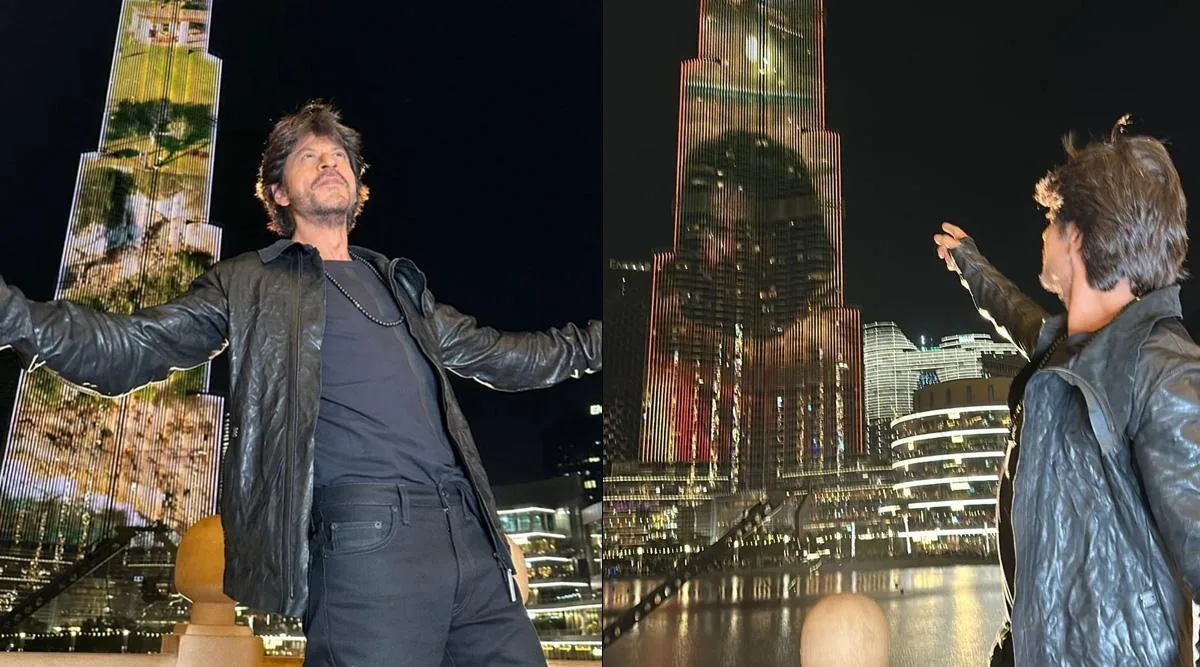
The Pathaan trailer on the Burj Khalifa, Dubai, 14 January 2023. (Images: Final Thesis archive)
The controversy and boycott calls surrounding the film generated a high level of public attention before release. The campaign’s limited public commentary did not eliminate the conversation; it left much of the conversation to unfold through news coverage, fan networks, and social media.
The important marketing distinction is that a brand can exercise narrative control by deciding what it releases, when it releases it, and which channels it uses. This is different from inventing an interactive digital experience.
(Final Thesis, section 10)
The film became the event
The official teaser, songs, trailer, and release itself became the central campaign assets. Pathaan was also positioned within YRF’s Spy Universe, giving it a larger franchise context rather than treating it as an isolated film.
Benchmark finding: Pathaan is a major example of strategic restraint and controlled publicity. It demonstrates how the star’s established audience and the scale of the film can make a relatively limited conventional promotional schedule generate extraordinary attention.
But its innovation is principally in publicity strategy, narrative control, timing, and franchise positioning—not a recreation of the Chennai Express train, game, karaoke, and fan-powered digital architecture.
(Final Thesis, section 10)
Pathaan: The power of controlled visibility
Reporting on the Pathaan campaign described a comparatively restrained approach to conventional media interaction, with direct-to-fan communication and selective public appearances playing prominent roles.
This approach illustrated a broader shift in celebrity marketing.
A star with a substantial digital audience does not necessarily need to depend on the traditional interview circuit to maintain visibility. Social posts, fan interactions, trailers, public appearances, and earned media can reinforce one another.
The celebrity becomes both the subject and a major distribution channel of the campaign.
However, direct-to-fan communication is not the same as fan ownership of the platform. A celebrity can speak directly to millions of followers while the underlying audience relationship remains mediated by a third-party service.
This is a central strategic distinction.
(Final Thesis, section 46)
Pathaan: The return of the action icon
Pathaan reintroduced Shah Rukh Khan in an action-led theatrical event, with the campaign built around the film’s action identity, music, visual reveals, star appearances and the broader YRF Spy Universe.
The film’s release became a major public event, with extensive media coverage and audience discussion.
For the case study, the relevant comparison with Ra.One is the management of anticipation. Both films used the recognisable star as a central promotional asset, but the technological and distribution environments were different.
In 2011, a bespoke website, game, graphic novel and physical merchandise were prominent campaign components.
By 2023, social platforms, online video, streaming distribution and fan-created edits operated at a vastly different scale.
The final paper should measure those differences through dated campaign assets and available platform data, rather than treating the volume of online conversation as a direct measure of unique audience reach.
(Final Thesis, section 62)
Abroad, the first weekend. Outside India, Pathaan took about US$25.4 million (₹207.21 crore) in its opening weekend, 27 to 29 January 2023, which Bollywood Hungama called the all-time highest overseas opening weekend for a Hindi film. In the United States alone it grossed $6,424,172 from 695 screens; in the UAE and the Gulf it took AED 29,090,318, or ₹64.59 crore. (Fact. Bollywood Hungama, 30 Jan 2023) Pinkvilla puts its final overseas gross at US$49.05 million, or ₹402 crore; a picture caption on the same page gives ₹398 crore. (Fact. Pinkvilla, Apr 2023, updated 17 Nov 2023)
Dhaka, 12 May 2023. Pathaan opened in Bangladesh on 12 May 2023, reported by AFP as the first Indian film to get a full release there in 50 years. Dhaka had banned films from its neighbour soon after independence, under lobbying from local film-makers; AFP dates the ban to 1971, ANI to 1972. (Fact. The Jakarta Post / AFP, 12 May 2023; ThePrint / ANI, 5 May 2023) The door had opened in February 2023, when 19 Bangladeshi film associations agreed to allow Hindi films, with ten a year suggested. (Fact. ThePrint / ANI, citing Variety, 5 May 2023) The same ANI report recalls Salman Khan’s Wanted (2009) and a figure of 50 cinemas, so whether Pathaan was the first Hindi film shown in Bangladesh, or only the first full release, is [Unverified]; a dated record of the Wanted screenings would settle it. (Method note)
The film that gave no interview at home was the one that reopened a market closed to Hindi cinema for half a century. (Analysis)