Part VII · The Next Frontier · 36 of 57
Chapter 34 · SRKWorld: a fan-franchising operating system
(Proposal) The return of SRKWorld, in the author’s design, is not a website. It is an operating system: shared rules under which independent fan communities create, collaborate and earn around a star’s world, instead of a campaign run entirely by a central marketing team.
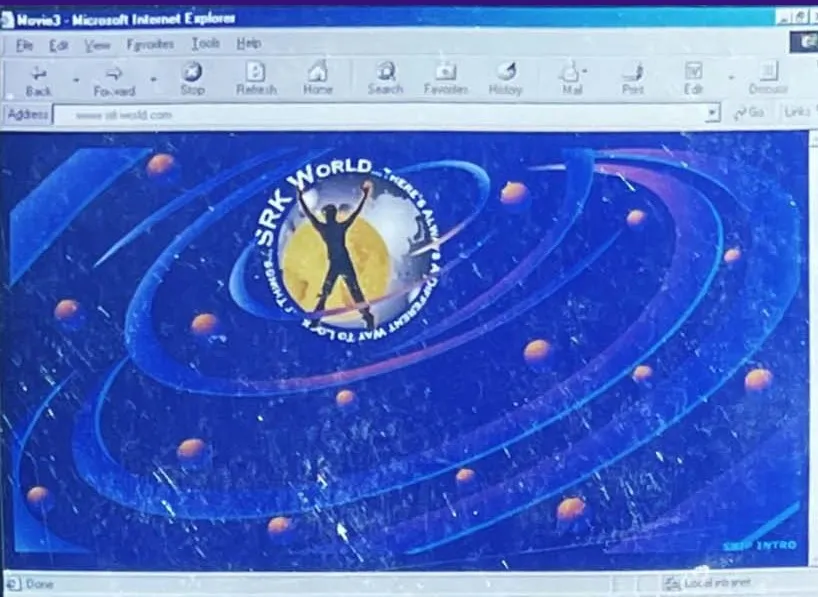
SRKWorld.com, 2000: the first version of the idea. (Archive: the author's collection)
- The film stays the centre: the event, the story and the intellectual property, owned by its owners.
- The fan brings identity, talent, imagination, community and original work.
- ijOO supplies a parallel universe of characters, stories and creative assets for fans to build with.
- The AI Bioskope turns watching into making: storytelling, visual creation and transformations, with the audience as co-creator.
- O TO X: My Math supplies the rules: original submissions, a shared timed round, transparent scoring (Part IX).
- Fan communities run the challenges, screenings and events.
(Proposal) What it would measure is not likes. It is original submissions, repeat participation, creative range, and the number of fan assets that earn permission for further use. And it would say plainly that participation is not commercial value: a million fan creations do not make a million commercial properties. (Analysis)
The rights question is the design. Any real fan franchise has to answer, before launch: who owns fan-made work; who controls the official IP; how creators are credited and paid; how AI is used, with what consent for face and voice; how the platform pays for itself; and how fans, especially minors, are protected. (Analysis) This is the difference between a participatory entertainment economy and an uncontrolled extraction of fan labour. (Analysis)
From the Final Thesis
Added from the Final Thesis, word for word. Where a figure here differs from the sourced figure earlier in this chapter, the chapter’s figure stands; see Addendum B.
The unfinished thread: SRKWORLD
There is one more part of this story that cannot be understood through public film announcements alone.
Gupta describes SRKWORLD as an early technology venture connected to her work with Shah Rukh Khan. In her account, the project was conceived around a technology-driven fan and entertainment ecosystem long before today’s AI-generated content platforms became mainstream.
Her résumé and project materials identify SRKWORLD among her ventures and describe work involving digital marketing, licensing, merchandising, technology and entertainment properties.
Her account is that the venture and its broader ambitions were interrupted, leaving an unfinished technological and creative thread.
These are her firsthand claims and professional history; the complete private history of the venture, the circumstances of its closure, the responsibilities of individual parties and any present-day revival have not been independently established in the public record.
That is precisely why the SRKWORLD connection belongs in the article as an open question, not a revelation of a secret arrangement.
What if the most interesting question about KING is not merely what the film will look like?
What if it is whether the next chapter of the Shah Rukh Khan entertainment ecosystem will revisit the idea that fans should be able to participate in the world of a film?
And what if the old idea of a fan-powered, open-source entertainment platform is newly relevant in a world where AI can help audiences create their own stories?
These are questions worth investigating.
They are not yet answers.
(Final Thesis, section 24)
The unfinished thread of SRKWORLD
Gupta’s account of SRKWORLD adds another dimension.
She describes the venture as an early attempt to connect technology, entertainment, digital marketing and fan engagement, drawing on her professional history with Shah Rukh Khan and her work across film campaigns, licensing and digital strategy.
Her account positions SRKWORLD as an unfinished technological and creative thread.
The public material available here does not establish a current SRKWORLD revival, a formal connection to KING, or a technology agreement involving FLAM.
Those remain questions for verification.
But the juxtaposition is striking:
An earlier fan-franchise ambition.
A global sports and entertainment ecosystem.
A new investment connection to interactive AI.
A film called KING.
The temptation is to connect all the dots and announce a secret master plan.
That would be premature.
The more interesting approach is to ask whether the conditions for a new kind of entertainment franchise are now emerging—and whether KING could become the place where those conditions converge.
(Final Thesis, section 37)
The open-source question
The most ambitious version of the proposal is not simply a website.
It is a fan franchising operating system — a framework in which independent communities can create, collaborate, and organise under shared standards.
The idea behind SRKWORLD is to explore whether fan participation can become a decentralised creative network rather than a campaign controlled entirely by a central marketing team.
That would require answers to difficult questions:
| Question | Strategic consideration |
|---|---|
| Who owns fan-created work? | Clear creator ownership, licensing terms, and permissions |
| Who controls official IP? | Rights remain with the relevant owners unless a licence provides otherwise |
| How are creators recognised? | Attribution, transparent selection criteria, and meaningful participation |
| How is AI used? | Disclosure, consent, safeguards, and clear limits on likeness and voice generation |
| How does the platform sustain itself? | Sponsorship, voluntary participation, licensed products, and other transparent business models |
| How are fans protected? | Privacy, moderation, child safety, anti-harassment rules, and accessible reporting |
The most important principle is that fan creativity should not be treated as an unlimited source of free commercial labour.
If fans are invited to contribute, the terms of participation should be transparent. If their work is selected for commercial use, the process should include appropriate permission, attribution, and compensation where agreed.
The ambition is to build with the community, not merely extract value from it.
(Final Thesis, section 48)
The rights question
Any genuine fan-franchising model would require clear rules around:
- The distinction between official intellectual property and fan-created work.
- Permission to use names, images, characters, film footage and music.
- Ownership and licensing of original fan contributions.
- Compensation and attribution where creative work is commercialised.
- AI training, face likeness, voice likeness and consent.
- Moderation, safety, data protection and dispute resolution.
This is not a footnote. It is the difference between a participatory entertainment ecosystem and an uncontrolled extraction of fan labour.
A sustainable model must create value for creators as well as rights holders.
The original proposition of SRKWORLD is therefore not simply to turn fans into marketers.
It is to explore whether fans can become recognised participants in an entertainment economy, with transparent rights and rules.
That is the contribution this case study can make beyond one celebrity’s career.
(Final Thesis, section 65)
The kingdom organises itself
A celebrity’s audience is not a single, undifferentiated mass.
It includes fan clubs, informal online communities, local organisers, collectors, artists, editors, writers, meme creators, filmmakers, merchandise buyers and people who simply watch the films.
Some fan communities operate independently. Others participate in official events or promotions. Their motivations, resources and relationships with the celebrity differ.
The rise of organised fan activity is therefore a subject in its own right.
It is also where the original marketing question becomes a technology question.
What would happen if a fan’s relationship with a film extended beyond watching and sharing?
What if a fan could create an original story, enter a competition, organise a screening, build a community, produce a game or contribute an authorised piece of merchandise?
What if participation could be measured transparently while preserving the fan’s creative rights?
These are the questions behind the proposed SRKWORLD concept.
(Final Thesis, section 64)
Why O TO X MY MATH belongs here
The O TO X MY MATH concept provides a more concrete example of the participation mechanics proposed for such an ecosystem.
The game framework includes an original creative submission with a 100-word limit, a selected transformation route, a shared timed round, scoring rules and the possibility of private rooms or public matchmaking.
The underlying principle is simple:
A participant contributes something original. The contribution is transformed under a common framework. The result can be evaluated through transparent rules.
That differs from a conventional promotional contest in which the primary activity is to like, share or comment on a branded post.
The proposed system could measure original submissions, repeat participation, community activity, creative diversity and the number of assets that receive permission for further use.
But participation metrics should not be confused with commercial value.
A million fan-created assets do not automatically create a million commercially viable properties. The rights, quality, consent, moderation, attribution and economics of each use matter.
(Final Thesis, section 65)
A LIVING FAN UNIVERSE
A potential ecosystem of stories, games, merchandise, community and licensed creative participation.
This is a proposed architecture. It is not evidence that Shah Rukh Khan, Red Chillies Entertainment or the producers of KING have authorised SRKWORLD, ijOO or a fan-franchising arrangement.
That distinction is essential to the credibility of the study.
(Final Thesis, section 65)