Part VII · The Next Frontier · 37 of 57
Chapter 35 · ijOO and the AI Bioskope
(Proposal) ijOO is the author’s original universe: its own characters and mythology, built for participatory storytelling, in which fans can create without borrowing anyone’s face. Its art is the author’s own. The AI Bioskope is the proposed stage for it: a cinema that the audience makes, where a fan’s idea becomes a scene, a scene becomes a story, and the story is credited to the fan who made it. (Proposal; Recollection, the author’s concepts)
[image: Shah Rock Jaan in the ijOO universe]
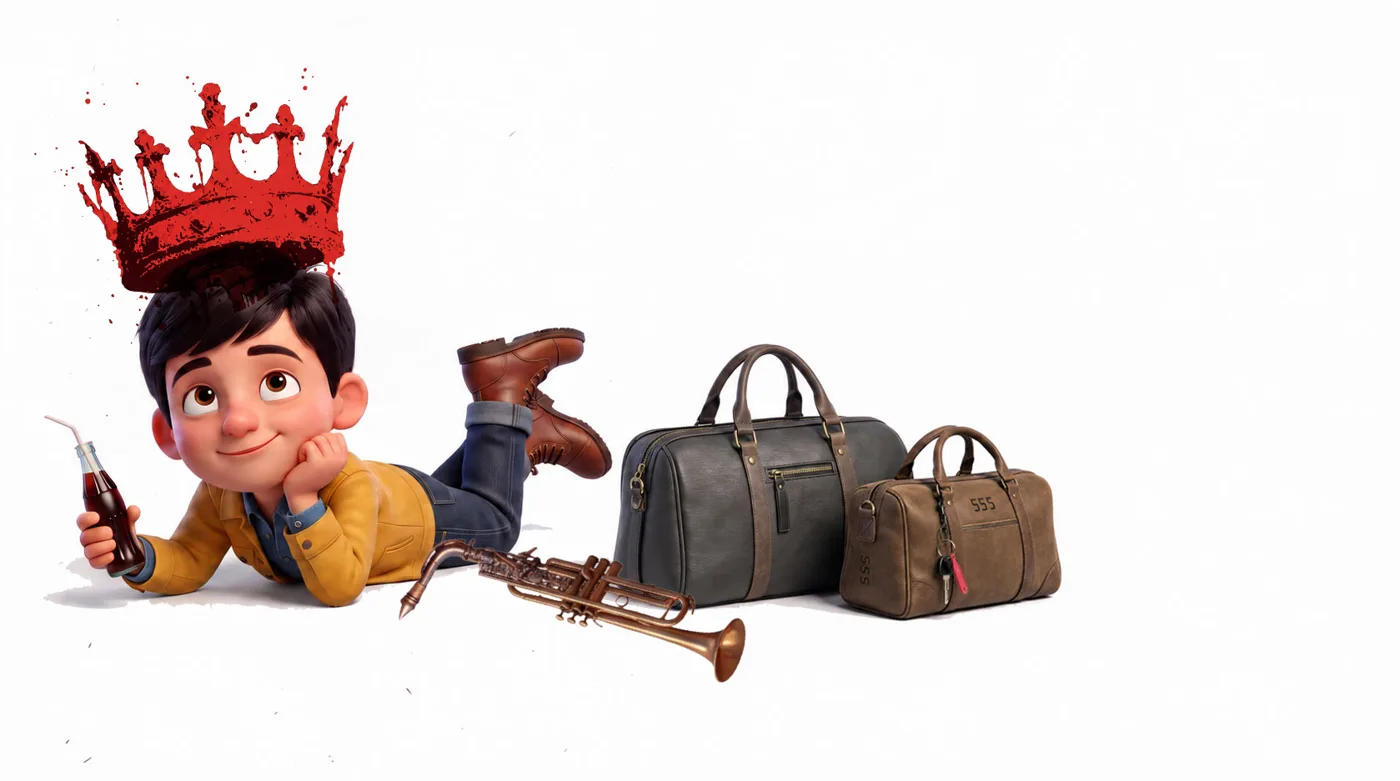
Shah Rock Jaan in the ijOO universe: an original character, carrying no star’s name or face. (The author’s art)
The two answer one problem from two sides. The AI tools of 2026 can put anyone’s face into anything. ijOO offers a world that needs no stolen face; the AI Bioskope offers a licensed stage where a borrowed one would be borrowed with permission. (Analysis)
From the Final Thesis
Added from the Final Thesis, word for word. Where a figure here differs from the sourced figure earlier in this chapter, the chapter’s figure stands; see Addendum B.
From KING to KINGDOM: The Unfinished Digital Opportunity
The next stage of this story does not have to be another film campaign.
It could be an entirely new relationship between a film, its intellectual property, its audience, and the technology that connects them.
The opportunity is particularly relevant in an era when generative AI enables ordinary users to create images, stories, videos, characters, games, and interactive experiences.
The question is no longer simply whether fans can share a poster.
It is whether they can participate in building the cultural universe around a film.
(Final Thesis, section 48)
Why AI changes the equation
The original Ra.One and Chennai Express campaigns required considerable resources to produce games, videos, digital assets, and interactive experiences.
AI-assisted tools can potentially lower the cost and technical barrier for some creative activities.
A fan could write a story, create a storyboard, generate original visual concepts, produce a short animation, or collaborate with other fans without requiring a professional production studio.
This does not make professional filmmaking obsolete. It expands the range of creative work that can be attempted.
The opportunity is to move from a model in which the studio creates all the campaign content to one in which the studio or an authorised platform provides the framework, creative resources, and safeguards for a much larger community of voluntary creators.
In that model, the fan is not merely the final recipient of the marketing message.
The fan can become a storyteller.
(Final Thesis, section 48)
The proposed KING FAN ARENA
Author’s proposal — not an official Shah Rukh Khan or KING initiative
Imagine an unofficial, fan-first creative environment where participation is not limited to liking, sharing, or commenting on a promotional post.
A platform where fans can create their own stories, develop characters, remix approved creative assets, collaborate with other fans, and share original work.
The concept could include the following modules:
A guided storytelling environment in which fans build short films, campaign concepts, and cinematic scenes using original material or appropriately licensed assets.
A participatory storytelling experience inspired by the spirit of Chennai Express, allowing fans to create journeys, adventures, characters, and stories across locations and cultures.
A creative framework built around transformation, choices, symbolic reversals, and the fan’s role in shaping a story. It could become a storytelling game, challenge, or collaborative narrative.
Existing communities could organise challenges, showcase fan-made work, host collaborative projects, and connect local audiences through language, culture, and shared creative interests.
A curated collection of publicly available and appropriately licensed references, original fan art, storyboards, campaign material, and creative resources.
The platform could begin with a relatively simple architecture: fan profiles, a media library, story-building tools, local saving and exporting, community challenges, and creator showcases.
More advanced features — AI-assisted storytelling, interactive characters, licensed franchise content, or commercial merchandise — would require separate decisions about technology, rights, privacy, moderation, and ownership.
The concept should not depend on unauthorised use of Shah Rukh Khan’s likeness, voice, film footage, trademarks, or copyrighted characters. Nor should fans be led to believe that an unofficial project is endorsed by the actor, Red Chillies Entertainment, or the producers of KING.
A sustainable fan ecosystem must protect both the creative freedom of participants and the rights of the people whose intellectual property makes the experience possible.
(Final Thesis, section 48)
The bioscope, then and now
The first show. Cinema in India began in a hotel. On 7 July 1896 the Lumière brothers’ short films were shown at Watson’s Hotel in Bombay, and later at the Novelty theatre. The cheapest ticket was four annas in the gallery; the best seats cost up to two rupees. (Fact. Deccan Herald, “The beginning of a dream world”, undated feature) ThePrint counts six Lumière films in that Bombay programme. Three years later H. S. Bhatavdekar filmed a wrestling match at the Hanging Garden, The Wrestlers (1899), the first motion picture made by an Indian, 14 years before Dadasaheb Phalke’s Raja Harishchandra (1913). (Fact. ThePrint, 15 March 2019)
The bioscope that travelled. For most of the century the screen also went to the audience. Touring talkies, cinemas in tents and trucks, have played the village fairs of Maharashtra for more than seven decades; in their heyday, the 1960s to the 1980s, hundreds of these itinerant screens were running. By 2017 perhaps a dozen or fewer remained in western Maharashtra. Their last showmen are the subject of the documentary The Cinema Travellers by Shirley Abraham and Amit Madheshiya. (Fact. MovieMaker, 28 August 2017)
The licensed stage, 2025. The business model the AI Bioskope proposes already has one large precedent. In December 2025 Disney agreed to invest US$1 billion in OpenAI and signed a three-year licence letting users of OpenAI’s Sora video app make content with more than 200 animated characters from Disney, Marvel, Pixar and Star Wars, starting in 2026. The deal, in the words of the statement announcing it, “does not include any talent likeness or voices”. (Fact. NPR, 11 December 2025)
Why it matters here. The Disney licence draws the same line ijOO draws: characters may be lent to fans, a living actor’s face and voice may not, unless he says so. The AI Bioskope adds the older Indian idea from the touring talkies: the show goes to the audience, and the audience fills the tent. Its difference is that the audience also makes the film. (Analysis)
The bioscope as a business. Before India made its own feature films, it built companies to show them. In 1898 Hiralal Sen founded the Royal Bioscope Company in Calcutta with Matilal Sen, Deboki Lal Sen and Bholanath Gupta. From 1901 to 1904 its films were mostly scenes from Classic Theatre stage productions; it also made some of the first advertisement films in India, and its production stopped in 1913 as newer ventures took the market. (Fact. Wikipedia: Royal Bioscope Company, read 13 Nov 2026)
The tent that became an empire. In 1902 Jamshedji Framji Madan began bioscope shows in a tent on the Maidan in Calcutta. In 1919 his business became a joint-stock company, Madan Theatres Limited, and that year it produced Bilwamangal, the first Bengali feature; two years earlier it had made Satyavadi Raja Harishchandra (1917), the first feature shot in Calcutta. At its peak in the late 1920s Madan Theatres owned 127 theatres and, by the same account, controlled half of the country’s box office. It went on producing films until 1937. (Fact. Wikipedia: Jamshedji Framji Madan, read 13 Nov 2026)
The tent that crossed the sea. Abdulally Esoofally, born in Surat in 1884, toured with a tent bioscope from 1908 to 1914 through Burma, Singapore and Indonesia, and is credited with introducing cinema there. He settled in Bombay in 1914 and went into exhibition with Ardeshir Irani, starting with the Alexandra Theatre and later the Majestic; the partnership lasted more than 40 years. (Fact. Indiancine.ma: Abdulally Esoofally, read 13 Nov 2026)
The order of things. In all three the screen came before the studio: a tent gathered an audience, the audience paid for theatres, and the theatres paid for films. (Analysis) The AI Bioskope proposes the same order: first a stage and an audience that creates, then a catalogue. (Proposal)
The screen learns to talk, and then to draw
The partners’ next leap. The Majestic, the theatre Esoofally and Irani ran together, also gave India its first talking picture. Alam Ara, made by Irani’s Imperial Film Company, premiered at Majestic Cinema, Bombay, on 14 March 1931 and ran there for eight weeks. It cost ₹40,000, ran 124 minutes and had seven songs; the first, “De De Khuda Ke Naam Pe Pyaare”, sung by Wazir Muhammad Khan, is acknowledged as the first song of Hindi cinema. Exact box-office figures are N/A; crowds queued from 9 am for a 3 pm first show. No print or gramophone record is known to survive, so India’s first talkie is a lost film. (Fact. Wikipedia: Alam Ara, read 23 Nov 2026)
The first AI epics, 2025 to 2026. Ninety-four years later the next change of medium arrived through the same mythology the touring talkies carried. JioStar and Collective Media Network announced Mahabharat: Ek Dharmayudh, billed as India’s first AI-powered premium entertainment series: a first instalment of 100 episodes, streaming on JioHotstar from 25 October 2025 and on Star Plus from 26 October 2025 at 7.30 pm. The release describes the AI’s role only in general terms. (Fact. JioStar press release, Mumbai, 18 October 2025) In August 2025 Abundantia Entertainment and Collective Media Network’s Historyverse division announced Chiranjeevi Hanuman – The Eternal, “India’s first AI-generated, theatrically positioned feature film”, built with more than 50 engineers from Galleri5, for a worldwide release on Hanuman Jayanti 2026. (Fact. The Hollywood Reporter India, 20 August 2025) That date passed: on 1 September 2026 NewsBytes, citing Variety India, reported the film pushed back because music and editing were still under way, with Rajesh Mapuskar directing and no new date given. (Fact. NewsBytes, 1 September 2026) Its release date is [Unverified]: an announcement by the producers would settle it.
What changed, and what did not. In 1931 the new medium was sound and the Majestic’s owners controlled both the studio and the screen. In 2025 the new medium is generated images, and again the studio and the platform sit in one deal. (Analysis) Neither AI epic puts a living star’s face on screen: both tell stories of gods, whose likeness no one owns. The AI Bioskope’s question is the one these productions leave open: who gets the credit when the audience, not the studio, does the generating. (Analysis; Proposal)